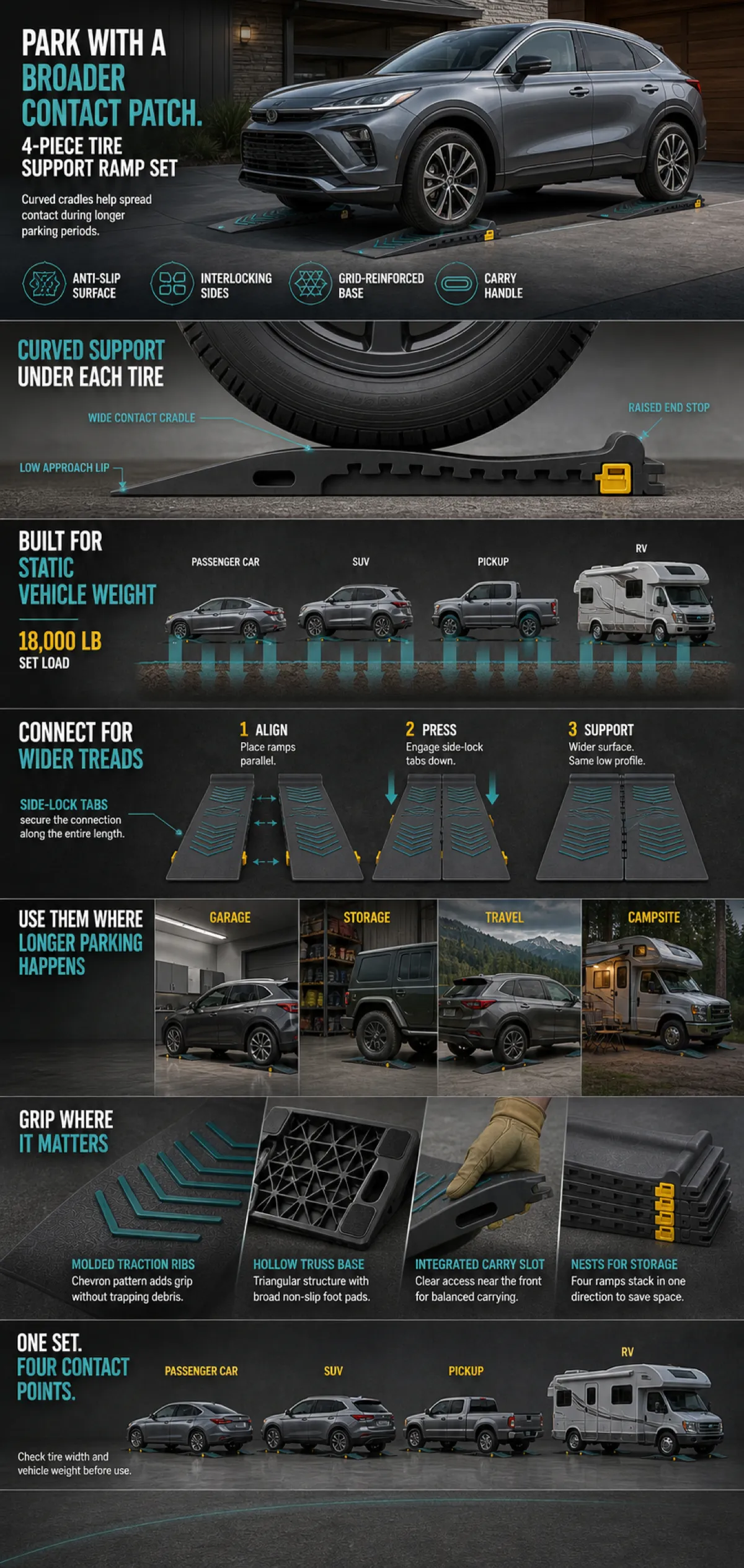
Create one complete vertical Amazon A+ preview image at 1200 px width with a naturally tall canvas. Use exactly seven visually continuous modules with no white or near-white horizontal separator lines. Use a rugged premium automotive palette of basalt gray, cool concrete, sea teal, signal yellow, and restrained natural outdoor color, with newly designed generic vehicles, bold condensed sans-serif typography, compact technical copy, clean icons, and subtle load graphics.
Use one locked modular tire-support ramp consistently throughout: a long low basalt-gray composite body with continuous shallow S-shaped longitudinal profile, feather-thin front approach lip, broad concave tire-contact cradle, rounded raised rear stop ridge, exactly three groups of sea-teal chevron traction ribs, long-side dovetail geometry, one signal-yellow side latch near the rear, integrated oval carry slot near the front side wall, and triangular underside truss. Maintain identical proportions, rib pattern, lip, cradle, stop, latch, slot, and truss in every single, connected, nested, and in-use view. Do not stretch, flatten, or substitute the ramp.
Module 1, approximately 17% height: a newly designed modern garage or driveway with one generic unbranded crossover parked statically, all four tires centered in four complete ramps, with the two near-side contact points clearly visible. Use “PARK WITH A BROADER CONTACT PATCH.”, “4-PIECE TIRE SUPPORT RAMP SET”, and “Curved cradles help spread contact during longer parking periods.” Add four icon labels: “ANTI-SLIP SURFACE”, “INTERLOCKING SIDES”, “GRID-REINFORCED BASE”, and “CARRY HANDLE”.
Module 2, approximately 14% height: an accurate longitudinal tire-and-ramp side cutaway with the tire centered inside the broad concave cradle, not on the entry slope and not pressing its sidewall against the stop. Use “CURVED SUPPORT UNDER EACH TIRE”, “WIDE CONTACT CRADLE”, “LOW APPROACH LIP”, and “RAISED END STOP”.
Module 3, approximately 13% height: show vertical load paths through the ramp into the ground and four generic unbranded vehicle silhouettes. Use “BUILT FOR STATIC VEHICLE WEIGHT”, “18,000 LB SET LOAD”, “PASSENGER CAR”, “SUV”, “PICKUP”, and “RV”.
Module 4, approximately 13% height: a clear three-step sequence showing two identical ramps aligned parallel along their long edges to create a wider support surface. Both approach lips point in the same direction and both rear stops align. Use “CONNECT FOR WIDER TREADS”, “SIDE-LOCK TABS”, and “ALIGN. PRESS. SUPPORT.”
Module 5, approximately 13% height: four newly designed compact lifestyle panels showing the same ramp in a garage, vehicle storage space, travel stop, and campsite. Use “USE THEM WHERE LONGER PARKING HAPPENS”, “GARAGE”, “STORAGE”, “TRAVEL”, and “CAMPSITE”.
Module 6, approximately 13% height: four detailed views integrated into one technical composition—sea-teal chevron ribs, triangular underside truss and floor pads, a gloved hand using the oval carry slot, and four identical ramps nested in one direction. Use “GRIP WHERE IT MATTERS”, “MOLDED TRACTION RIBS”, “HOLLOW TRUSS BASE”, “INTEGRATED CARRY SLOT”, and “NESTS FOR STORAGE”.
Module 7, approximately 12% height: arrange one set of four identical ramps with four generic unbranded vehicle types. Use “ONE SET. FOUR CONTACT POINTS.”, “PASSENGER CAR”, “SUV”, “PICKUP”, “RV”, and “Check tire width and vehicle weight before use.” Reserve the final 5% of the full canvas as empty basalt-gray ground with one extremely faint sea-teal arc fading out.
All vehicles, garages, outdoor settings, people, icons, load graphics, and step visuals must be newly designed and contain no vehicle badge. Keep every word and number exact, correctly spelled, and legible. Do not include original or invented brands, official vehicle approvals, traffic-safety certifications, claims that the product absolutely protects tires or extends tire life, 40,000 lb, prices, calls to action, shopping UI, pagination dots, module labels, filenames, canvas dimensions, placeholders, gibberish, flat-board substitutes, tires on the wrong ramp region, end-to-end interlocks, white divider lines, or content inside the bottom safety zone. Do not crop the final module.