【Execution Route | Must Not Appear on Screen】
If the image-generation tool can be invoked multiple times: concatenate the sharing rules with A–F separately and execute six times; each time, generate only one independent 1000×1000 square image, resulting in six sub‑images.
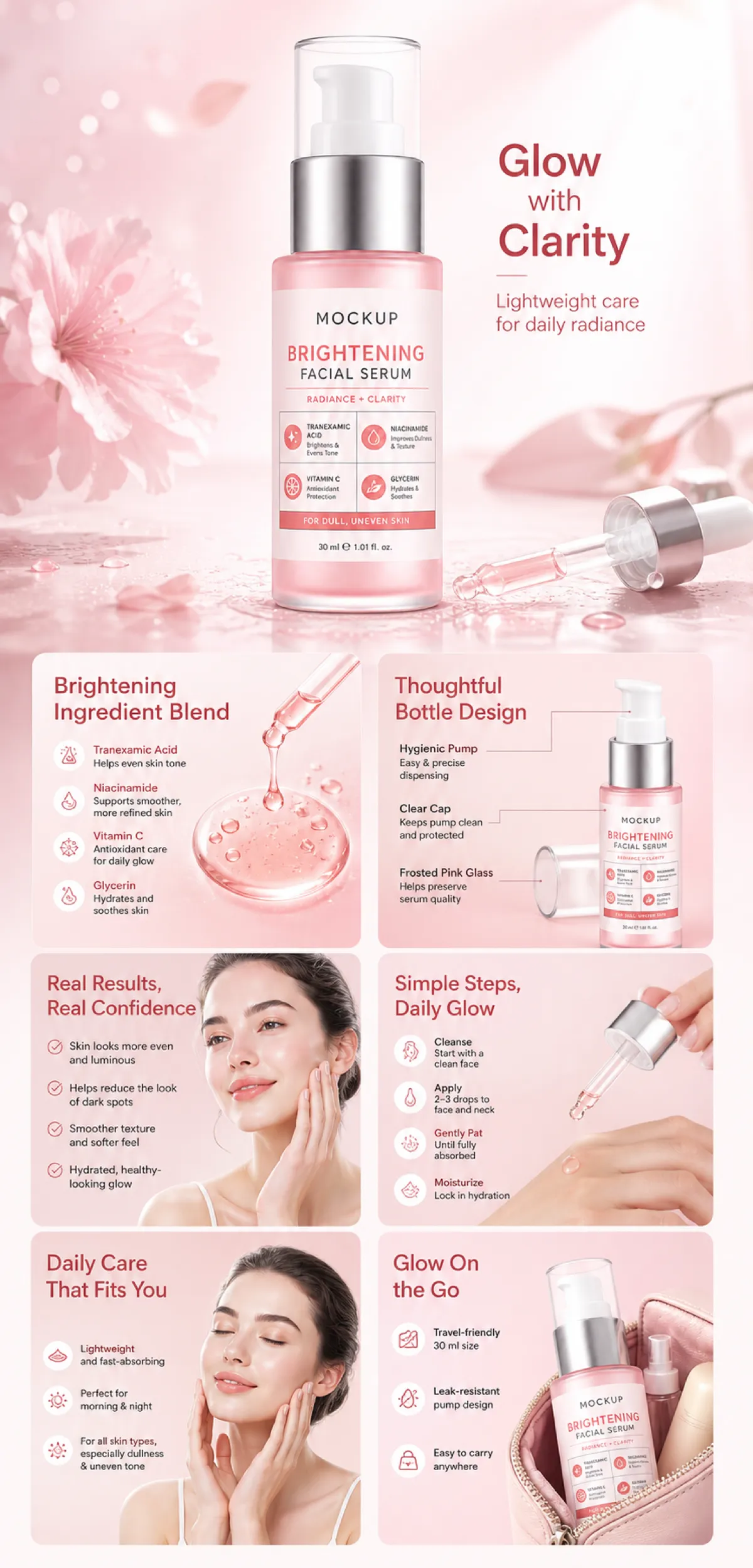
If single‑shot generation is permitted: use a 2:3 vertical canvas measuring 1200×2500, with the top approximately 30% reserved for the product’s main visual integrated into the background, and arrange the remaining area into a 2‑column × 3‑row grid labeled A/B, C/D, and E/F. All six cards should be of equal size, with an aspect ratio close to 1:1. Do not use a 1:1 outer frame, nor full‑width cards, cross‑column cards, merged cards, borders, frames, or white margins.
【Sharing Rules】
The provided product reference image serves as the sole basis for the product’s appearance, structure, color, quantity, accessories, and relative proportions. Product orientation: pink tranexamic acid skincare serum bottle, white cap, and label; texture, application, daily care, and portability—avoid making absolute whitening claims. The product itself, along with any newly generated characters, animals, props, or text, must maintain natural proportions; stretching, flattening, or non‑uniform scaling is prohibited. The background should extend fully across all four edges. Branding must uniformly follow MOCKUP; remove original branding, logos, watermarks, contact information, social media accounts, platform details, gibberish, and irrelevant content. Copywriting should be concise, clear, and credible, maintaining the language of the reference image, without adding unsupported absolute or medical claims. A–F are merely control markers and must not appear on screen.
【A | Core Selling Point】
Highlight the product’s most important value and its complete main subject; keep the headline short and clear.
【B | Structure and Materials】
Showcase the product’s key structure, materials, or components using close-up shots or simple annotations, adhering to the product’s intended orientation.
【C | Real‑World Use】
Generate natural human/animal figures or everyday scenes to demonstrate realistic usage, ensuring proportions and actions appear believable.
【D | Details and Steps】
Use close‑ups, step‑by‑step instructions, or flowcharts to explain operations, textures, interfaces, storage solutions, or care details.
【E | Lifestyle】
Depict how the product naturally integrates into family life, commuting, outdoor activities, travel, or work settings.
【F | Sets and Portability】
Accurately present the product, its accessories, quantities, and storage relationships; do not add any elements absent from the reference image.