
- 476K
- 152
- $190
Packaging Mockup Creative Inspiration
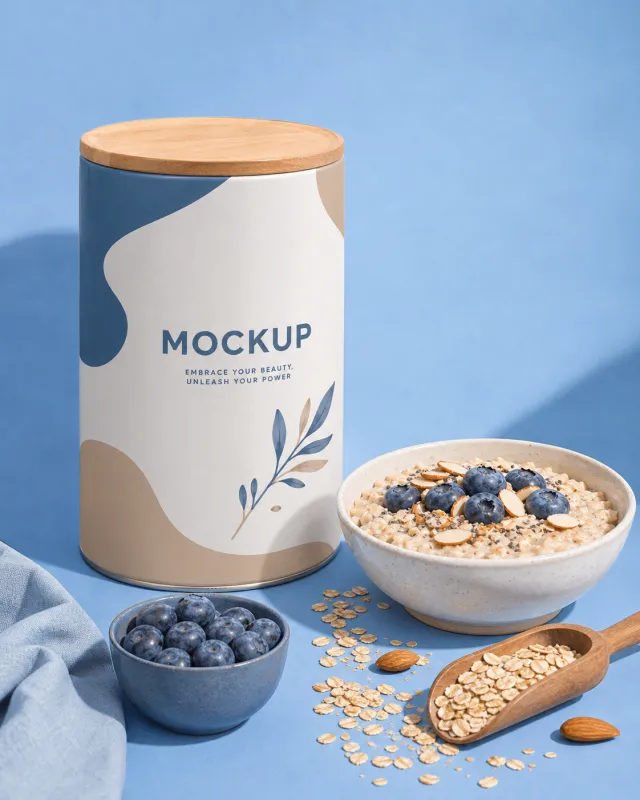
Use the supplied reference image as the sole locked product input. Preserve the product's exact appearance, structure, materials, colors, proportions, logo, label, accessories, and product-set relationship. Create a 561:701 photorealistic commercial product poster. Place the single oat canister with wooden lid upright beside a bowl of oatmeal topped with blueberries. Add a blueberry bowl, wooden scoop, scattered oats and almonds, soft blue fabric, and a blue tabletop and wall. Use a polished premium advertising finish with crisp product focus, coherent perspective, realistic materials, controlled depth of field, and physically plausible lighting. Keep all decorative elements physically plausible and subordinate to the product. Keep existing product text legible when present. No poster text, watermark, extra product, unrelated logo, distorted object, changed product appearance, or unnecessary person.
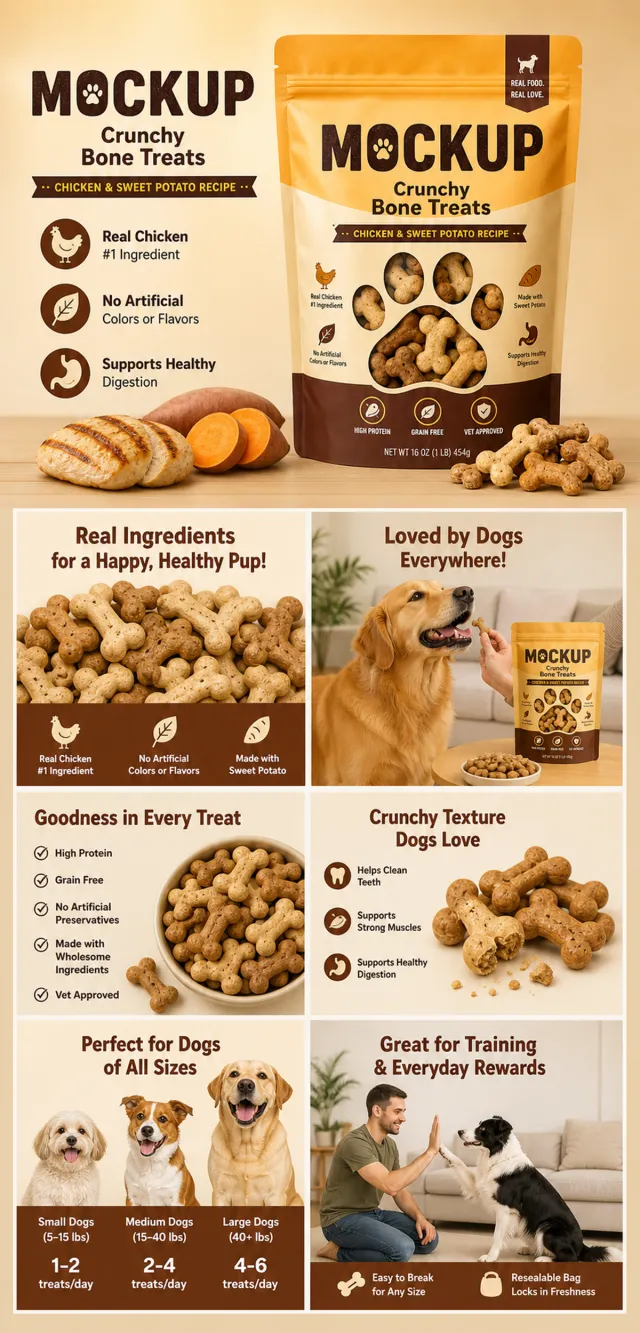
【Execution Routing | Do Not Display】 If the image-generation tool can be invoked multiple times: concatenate the sharing rules with A–F separately, execute six times, generating one 1000×1000 square image each time; do not submit all modules at once. If only one image can be generated per invocation: set the interface or API to a 2:3 portrait orientation and disable Auto mode; a recommended size is 1200×1800. Arrange A/B, C/D, and E/F into a 2-column × 3-row grid of six modules, ensuring equal module sizes and maintaining a 1:1 aspect ratio. If the platform enforces a 1:1 ratio, switch to using an Agent or generate each module individually. 【Sharing Rules】 The provided product reference image serves as the sole product basis. Product: crunchy dog bone treats. Copywriting must be in English, with brand placeholders replaced by MOCKUP only. Visuals should employ premium commercial e-commerce photography and stable graphic design. The product’s appearance, structure, color, quantity, accessories, and relative proportions must match the reference image; products, people, icons, and props should maintain natural proportions. All essential information must remain within the safe zone, with the background extending fully to all four edges. External white borders, vertical sidebars, transparent fill-in areas, watermarks, contact details, social media accounts, platform information, original branding, gibberish, irrelevant content, or unverified claims regarding efficacy or specifications are prohibited. Headlines must not be displayed. A–F must not appear. 【A | Core Selling Point】Write concise English copy that highlights this theme, focusing on the core value through the full product visual. 【B | Usage Instructions】Provide brief English copy that explains the usage process, combinations, or key operations. 【C | Applicable Scenarios】Offer succinct English copy showcasing realistic, credible, and product-relevant use cases. 【D | Functional Details】Present concise English copy that clarifies structural and functional details using close-up shots, cross-sections, or icons. 【E | Daily Maintenance】Include brief English copy detailing how to use, clean, store, or maintain the product. 【F | Specification List】Provide concise English copy listing materials, dimensions, packaging details, or credible comparisons—without fabricating parameters.
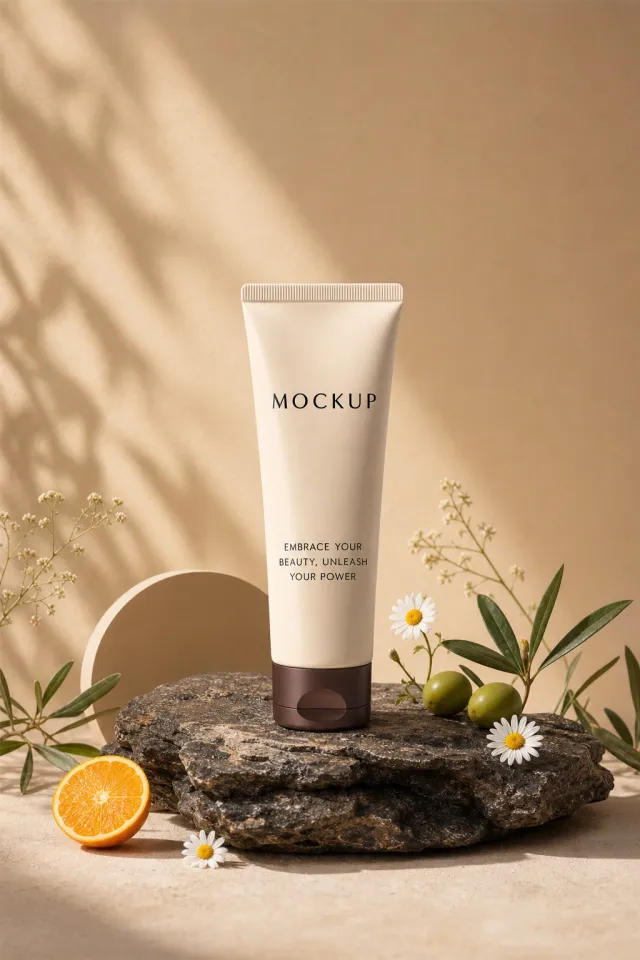
Use the white-background product image as the locked reference. Create a vertical warm beige skincare poster with a cream cleanser tube on a dark stone slab, small daisies, green olives, orange slice, botanical stems, and a soft circular prop. Keep only the product text "MOCKUP" and "EMBRACE YOUR BEAUTY, UNLEASH YOUR POWER". Remove all other product text and all poster text. Change prop placement, stone shape, lighting, and product angle from the original.
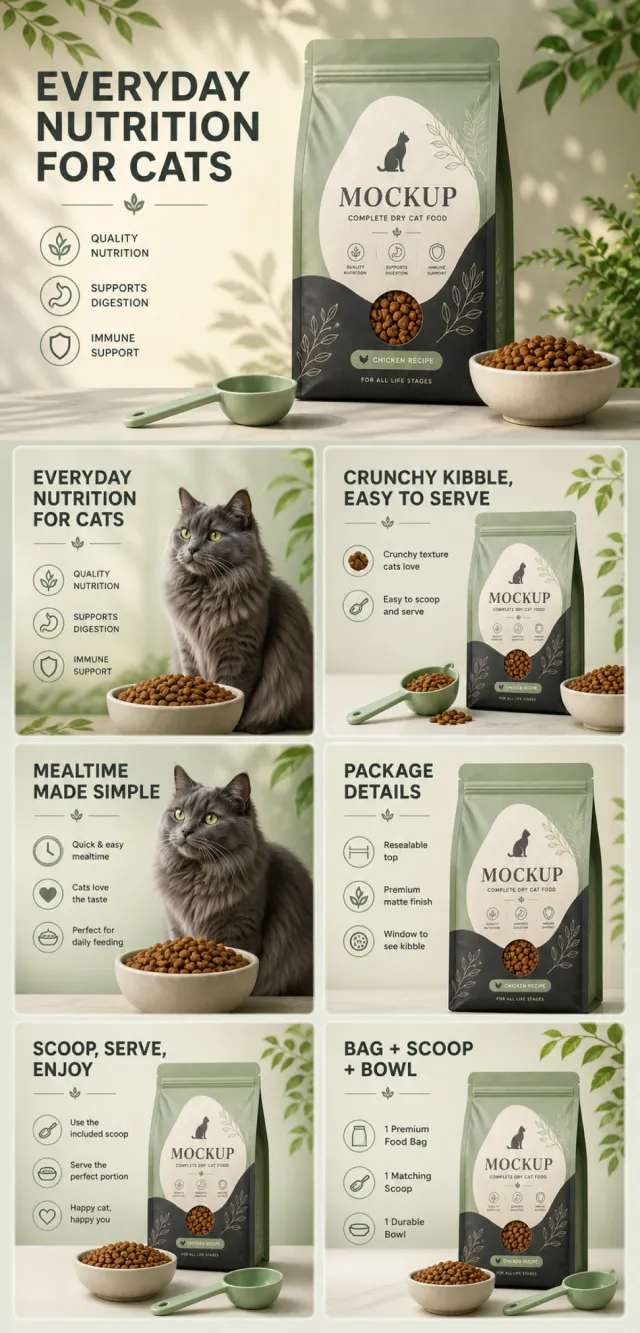
【Execution Route | Must Not Appear on Screen】 If the image-generation tool can be invoked multiple times: concatenate the sharing rules with A–F separately, and execute six times; each time generating only one 1000×1000 square image. If only a single image can be generated at a time: first set the interface/API to a 2:3 portrait orientation and disable Auto; then generate a 2-column × 3-row grid labeled A/B, C/D, and E/F. All six cells must be equal in size, with a visual ratio of 1:1. Do not use an outer canvas with a 1:1 aspect ratio. 【Sharing Rules】 The provided product reference image serves as the sole basis for the product’s appearance, structure, color, quantity, accessories, and relative proportions. The product is a resealable cat food bag in sage green and charcoal gray, featuring a cream-colored label, botanical line art, and round kibble windows, accompanied by a mint-green measuring spoon and a bowl of dry food. The visual style employs natural, premium pet-food aesthetics in sage green, cream white, and charcoal gray, with clear English typography, soft daylight, and plant-inspired elements. Products, people, animals, text, icons, and props must maintain their natural proportions; stretching or independent scaling is prohibited. All essential information must remain within the safe zone, while the background extends fully across all four edges. Only MOCKUP should be used for branding. Remove any surrounding white borders, vertical sidebars, numbered corner marks, watermarks, contact information, social media accounts, original brand logos, platform details, gibberish, distorted limbs, and unrelated content. People and animals must be recreated from scratch. Copywriting should be concise, readable, and trustworthy; A–F are solely control markers and must not appear on screen. 【A | Core Selling Point】Title: “EVERYDAY NUTRITION FOR CATS.” The hero composition features a cat food bag alongside a newly rendered adult cat, creating an overall natural, high-end aesthetic—without mentioning medical claims or absolute efficacy. 【B | Kibble Display】Title: “CRUNCHY KIBBLE, EASY TO SERVE.” Close-up shots of the bowl, measuring spoon, and kibbles showcase authentic texture and appropriate portion sizes. 【C | Dining Scene】Title: “MEALTIME MADE SIMPLE.” An adult cat enjoys its meal in a bright, homey setting, with packaging and the measuring spoon clearly visible. 【D | Packaging Details】Title: “PACKAGE DETAILS.” Four close-up shots highlight the sealed top, stable bag bottom, kibble window, and botanical line art. 【E | Usage Instructions】Title: “SCOOP, SERVE, ENJOY.” Three simple actions without numbers: open the package, measure out the food, and pour it into the bowl. 【F | Set Contents】Title: “BAG + SCOOP + BOWL.” A complete product set featuring the bag, a mint-green measuring spoon, and a bowl neatly arranged.
- 5M
- 2K
- $321
- 288K
- 939
- $161
- 297K
- 1K
- $24K
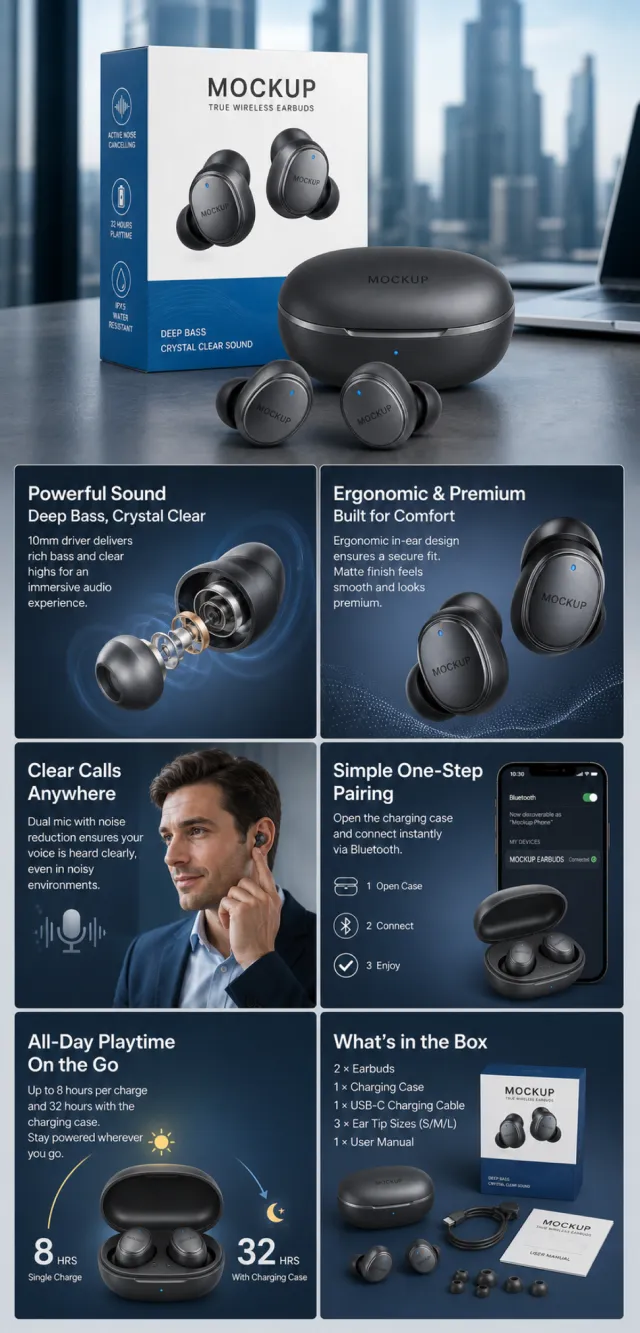
【Execution Route | Must Not Appear on Screen】 If the image-generation tool can be invoked multiple times: concatenate the sharing rules with A–F separately, and execute six times; each time, generate only one independent 1000×1000 square image, resulting in six sub-images. If single‑shot generation is permitted: use a 2:3 vertical canvas measuring 1200×2500, with the top approximately 30% reserved for the product’s main visual integrated into the background, and arrange A/B, C/D, and E/F in two columns by three rows to form a six‑grid layout; all six cards should be equal in size and maintain an aspect ratio close to 1:1. Do not use a 1:1 outer canvas, nor full‑width cards, cross‑column cards, merged cards, borders, frames, or white margins. 【Sharing Rules】 The provided product reference image serves as the sole basis for the product’s appearance, structure, color, quantity, accessories, and relative proportions. Product orientation: gray‑blue true wireless earbuds, charging case, and packaging box; focusing on wearing, connectivity, calls, battery life, and portability. The product itself, along with any newly generated characters, animals, props, or text, must maintain natural proportions—stretching, flattening, or non‑uniform scaling is prohibited—and the background must extend fully across all four edges. Branding must uniformly follow the MOCKUP style; remove original branding, logos, watermarks, contact information, social media accounts, platform details, gibberish, and irrelevant content. Copywriting should be concise, clear, and credible, retaining the language of the reference image, without adding unverified absolute claims or medical promises. A–F are merely control markers and must not appear on screen. 【A | Core Selling Point】 Highlight the product’s most important value and its complete main subject; keep the title short and clear. 【B | Structure and Materials】 Showcase the product’s key structures, materials, or components using close‑up shots or simple annotations, adhering to the product’s intended direction. 【C | Real‑World Use】 Generate natural human/animal figures or everyday scenes to demonstrate realistic usage, ensuring proportions and actions appear believable. 【D | Details and Steps】 Use close‑ups, step‑by‑step instructions, or flowcharts to explain operations, textures, interfaces, storage, or maintenance details. 【E | Lifestyle】 Illustrate how the product naturally integrates into family life, commuting, outdoor activities, travel, or work settings. 【F | Sets and Portability】 Accurately depict the product, its accessories, quantities, and storage relationships; do not add any components absent from the reference image.
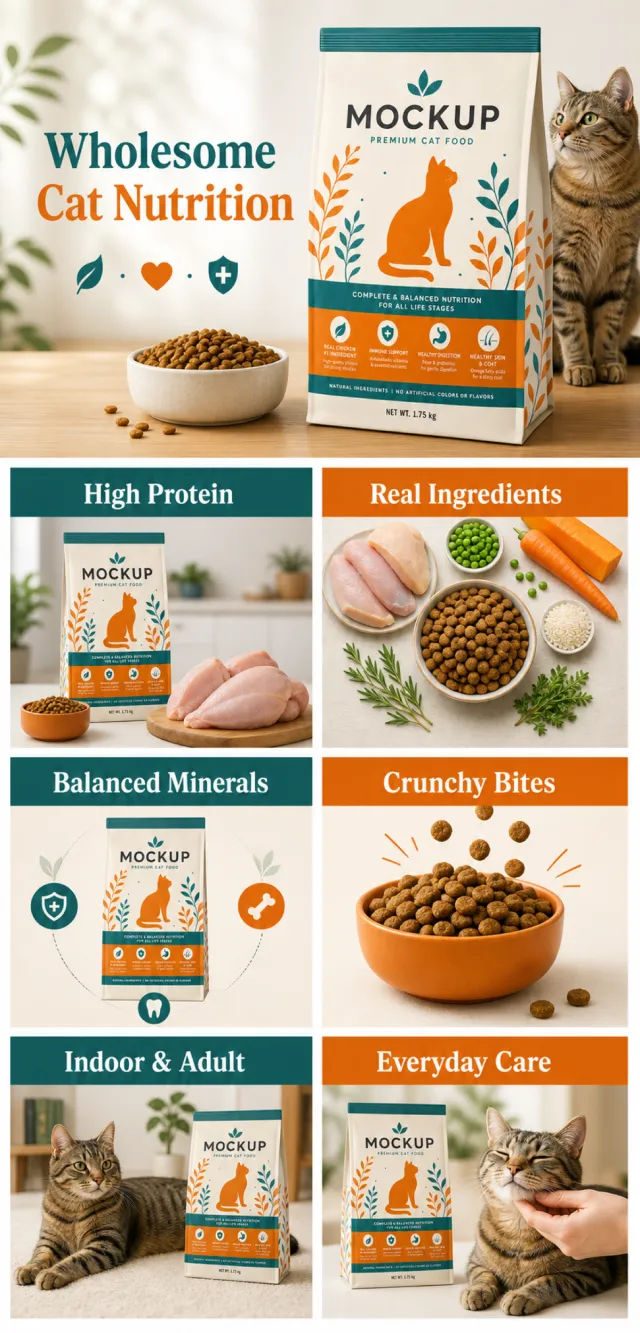
【Execution Routing | Do Not Display】 If the image-generation tool can be invoked multiple times: concatenate the sharing rules with A–F separately, execute six times, generating one 1000×1000 square image each time; do not submit all modules at once. If only one image can be generated per run: set the interface or API to a 2:3 portrait orientation and disable Auto mode; a recommended size is 1200×1800. Arrange A/B, C/D, and E/F into a 2-column × 3-row grid of six modules, ensuring equal module sizes and maintaining a 1:1 aspect ratio. If the platform enforces a 1:1 ratio, switch to using an Agent or generate each module individually. 【Sharing Rules】 The provided product reference image serves as the sole product basis. Product: premium dry cat food. Copywriting must be in English, with brand placeholders replaced by MOCKUP only. Visuals should incorporate orange, teal, cream, and charcoal. The product’s appearance, structure, colors, quantity, accessories, and relative proportions must match the reference image; products, figures, icons, and props should maintain natural proportions. All essential information must remain within the safe zone, with the background extending fully across all four edges. External white borders, vertical sidebars, transparent padding, watermarks, contact details, social media accounts, platform information, original branding, gibberish, irrelevant content, or unverified claims regarding efficacy or specifications are prohibited. Headlines must not be displayed. A–F must not appear. 【A | Theme】Copy: “Wholesome Cat Nutrition”; use the full product main visual to prominently convey the core value. 【B | Theme】Copy: “High Protein”; design an independent square image around this theme, avoiding overlapping selling points, compositions, and product angles with other modules. 【C | Theme】Copy: “Real Ingredients”; design an independent square image around this theme, avoiding overlapping selling points, compositions, and product angles with other modules. 【D | Theme】Copy: “Balanced Minerals”; design an independent square image around this theme, avoiding overlapping selling points, compositions, and product angles with other modules. 【E | Theme】Copy: “Crunchy Bites”; design an independent square image around this theme, avoiding overlapping selling points, compositions, and product angles with other modules. 【F | Theme】Copy: “Indoor & Adult” and “Everyday Care”; design independent square images around these themes, avoiding overlapping selling points, compositions, and product angles with other modules.
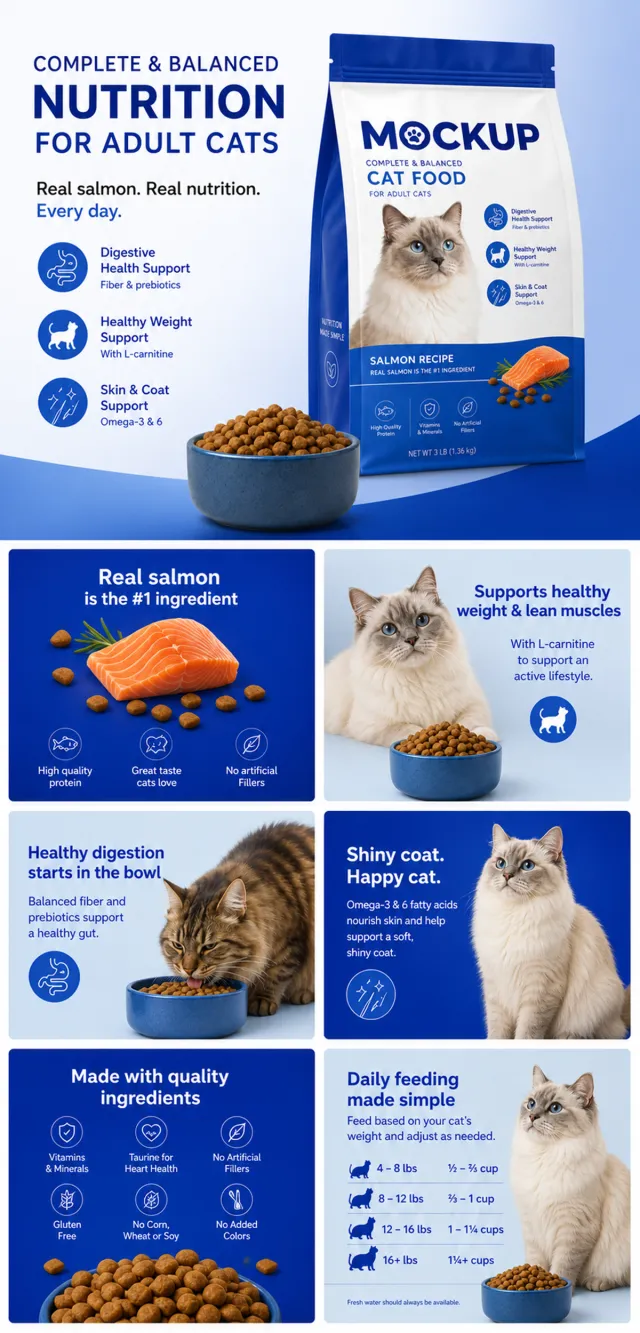
【Execution Routing | Do Not Display】 If the image-generation tool can be invoked multiple times: concatenate the sharing rules with A–F separately, execute six times, generating one 1000×1000 square image each time; do not submit all modules at once. If only one image can be generated per run: set the interface or API to a 2:3 portrait orientation and disable Auto mode; a recommended size is 1200×1800. Arrange A/B, C/D, and E/F into a 2-column × 3-row grid of six modules, ensuring equal module sizes and maintaining a 1:1 aspect ratio. If the platform enforces a 1:1 ratio, switch to using an Agent or generate each module individually. 【Sharing Rules】 The provided product reference image serves as the sole basis for the product. Product: cat food. Copywriting must be in English, with brand placeholders replaced by MOCKUP only. Visuals should follow premium commercial e-commerce photography standards and stable graphic design principles. The product’s appearance, structure, color, quantity, accessories, and relative proportions must match the reference image; products, people, icons, and props should maintain natural proportions. All essential information must remain within the safe zone, with the background extending fully across all four edges. External white borders, vertical borders on left and right, transparent fill-in borders, watermarks, contact details, social media accounts, platform information, original branding, garbled text, irrelevant information, or unverified claims regarding efficacy or specifications are prohibited. Headlines must not be displayed. A–F must not appear. 【A | Core Selling Point】Write concise English copy that highlights the theme, focusing on the core value through the full product visual. 【B | Usage Instructions】Provide brief English copy explaining the theme, illustrating the usage process, combinations, or key operations. 【C | Applicable Scenarios】Present short English copy describing real-world, credible scenarios relevant to the product. 【D | Functional Details】Offer succinct English copy addressing the theme, using close-up shots, cross-sections, or icons to clarify structural and functional details. 【E | Daily Maintenance】Provide brief English copy outlining methods for use, cleaning, storage, or maintenance. 【F | Specification List】Present concise English copy detailing materials, specifications, packaging contents, or reliable comparisons—without fabricating parameters.
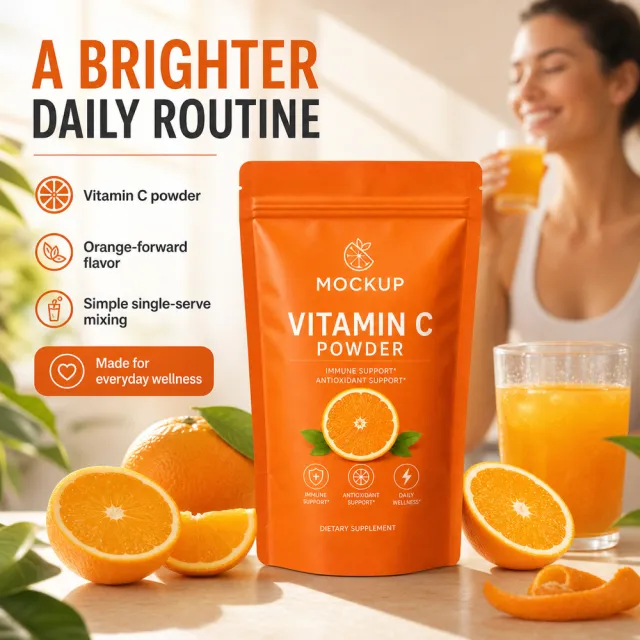
Create one standalone square 1000x1000 Amazon listing image for an orange vitamin C supplement pouch. Use the original image only for visual direction and the complete white-background product image as the only product geometry reference. Recreate a warm citrus-inspired wellness scene with the intact pouch, orange slices, a glass of water and a fresh daily-routine composition. Rewrite every visible claim from scratch in English: "A BRIGHTER DAILY ROUTINE"; "Vitamin C blend"; "Easy single-serve format"; "Citrus-inspired taste"; "Simple support for busy days". Do not copy source wording, logos, watermarks or contact details. No collage, grid, split screen, white border, side bars, cutaway or stretched product.
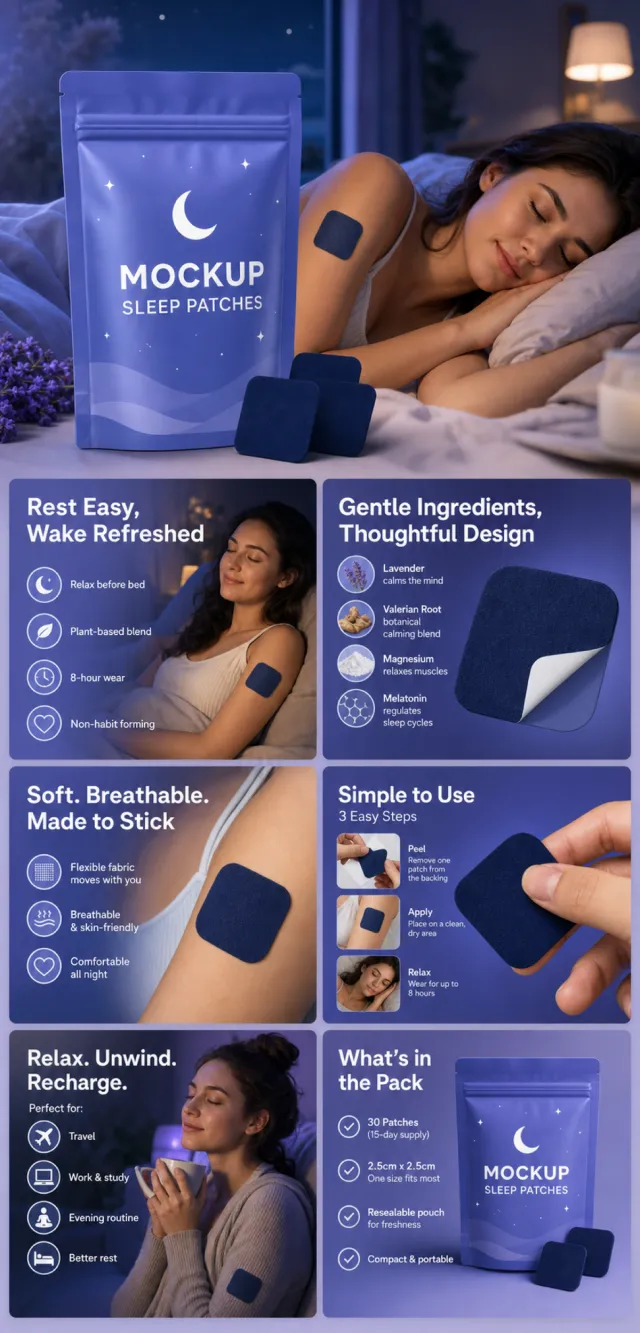
【Execution Route | Must Not Appear on Screen】 If the image-generation tool can be invoked multiple times: concatenate the sharing rules with A–F separately and execute six times; each time, generate only one independent 1000×1000 square image, resulting in six sub-images. If only single‑shot generation is allowed: use a 2:3 vertical canvas measuring 1200×2500, with approximately 30% at the top reserved for the product’s main visual integrated into the background, and arrange the remaining area into a 2‑column × 3‑row grid labeled A/B, C/D, and E/F. All six cards should be equal in size, with an aspect ratio close to 1:1. Do not use a 1:1 outer canvas, nor full‑width cards, cross‑column cards, merged cards, borders, frames, or white margins. 【Sharing Rules】 The provided product reference image serves as the sole basis for the product’s appearance, structure, color, quantity, accessories, and relative proportions. Product orientation: light purple sleep‑patch storage bag paired with navy blue square patches; designed for nighttime bedroom use, soft and comfortable fit, pre‑sleep relaxation, and portable storage. The product itself, along with any newly generated characters, animals, props, or text, must maintain natural proportions—stretching, flattening, or non‑uniform scaling is prohibited—and the background must extend fully across all four edges. Branding must uniformly follow the MOCKUP style; remove original branding, logos, watermarks, contact information, social media accounts, platform details, gibberish, and irrelevant content. Copywriting should be concise, clear, and credible, retaining the language of the reference image without adding unsupported absolute claims or medical promises. A–F are merely control markers and must not appear on screen. 【A | Core Selling Point】 Highlight the product’s most important value and its complete main subject; keep the headline short and clear. 【B | Structure & Materials】 Showcase key structural elements, materials, or components using close-up shots or simple annotations, adhering to the product’s intended direction. 【C | Real‑World Use】 Generate natural scenes featuring people, animals, or everyday life to demonstrate realistic usage, ensuring proportions and actions appear believable. 【D | Details & Steps】 Use close-ups, step-by-step instructions, or flowcharts to explain operations, textures, interfaces, storage solutions, or care details. 【E | Lifestyle】 Illustrate how the product seamlessly integrates into daily life scenarios such as home, commuting, outdoor activities, travel, or work. 【F | Sets & Carrying】 Accurately depict the product, its accessories, quantities, and storage relationships; do not add any components absent from the reference image.
- 3M
- 2K
- $27K
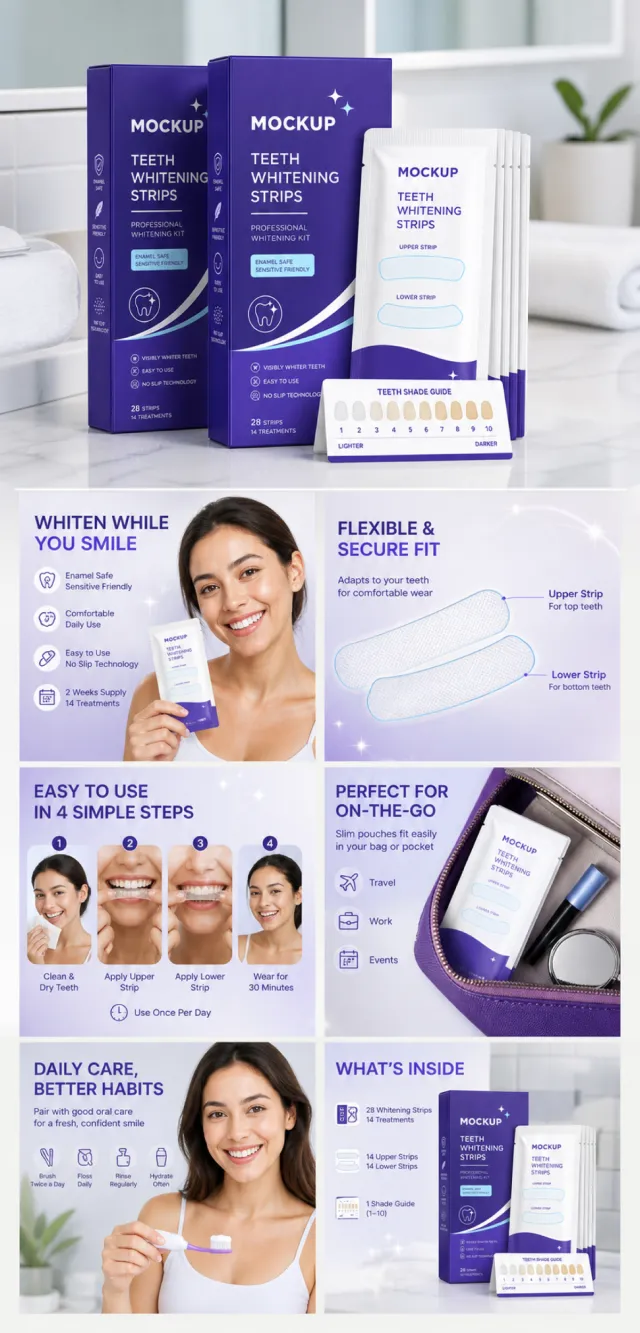
【Execution Route | Must Not Appear on Screen】 If the image-generation tool can be invoked multiple times: concatenate the sharing rules with A–F separately and execute six times; each time, generate only one independent 1000×1000 square image, resulting in six sub-images. If only single‑shot generation is allowed: use a 2:3 vertical canvas measuring 1200×2500, with approximately 30% at the top reserved for the product’s main visual integrated into the background, and arrange the remaining area into a 2‑column × 3‑row grid labeled A/B, C/D, and E/F. All six cards should be equal in size, with an aspect ratio close to 1:1. Do not use a 1:1 outer canvas, nor full‑width cards, cross‑column cards, merged cards, borders, frames, or white margins. 【Sharing Rules】 The provided product reference image serves as the sole basis for the product’s appearance, structure, color, quantity, accessories, and relative proportions. Product orientation: tooth‑whitening strip packaging paired with individual strips; emphasize fit, application steps, oral care, and portability, while avoiding absolute whitening claims. Maintain natural proportions for the product itself as well as any newly generated characters, animals, props, or text—no stretching, flattening, or non‑uniform scaling is permitted; ensure the background extends fully across all four edges. Use MOCKUP consistently for branding; remove original brand elements, logos, watermarks, contact information, social media handles, platform details, gibberish, and irrelevant content. Copywriting should be concise, clear, and credible, retaining the language of the reference image and refraining from adding unsupported absolute or medical claims. A–F are merely control markers and must not appear on screen. 【A | Core Selling Point】 Highlight the product’s most important value proposition and its complete main subject; keep the headline short and straightforward. 【B | Structure & Materials】 Showcase key structural features, materials, or components using close-up shots or simple annotations, adhering to the product’s intended direction. 【C | Real‑World Usage】 Generate natural human/animal figures or everyday scenes to demonstrate realistic usage, ensuring believable proportions and actions. 【D | Details & Steps】 Use close‑up views, step‑by‑step instructions, or flowcharts to explain operations, textures, interfaces, storage solutions, or maintenance details. 【E | Lifestyle Integration】 Illustrate how the product seamlessly fits into daily life scenarios such as home, commuting, outdoor activities, travel, or work. 【F | Sets & Portability】 Accurately depict the product, its accessories, quantities, and storage relationships; do not add any components absent from the reference image.
- 2M
- 4K
- $278K
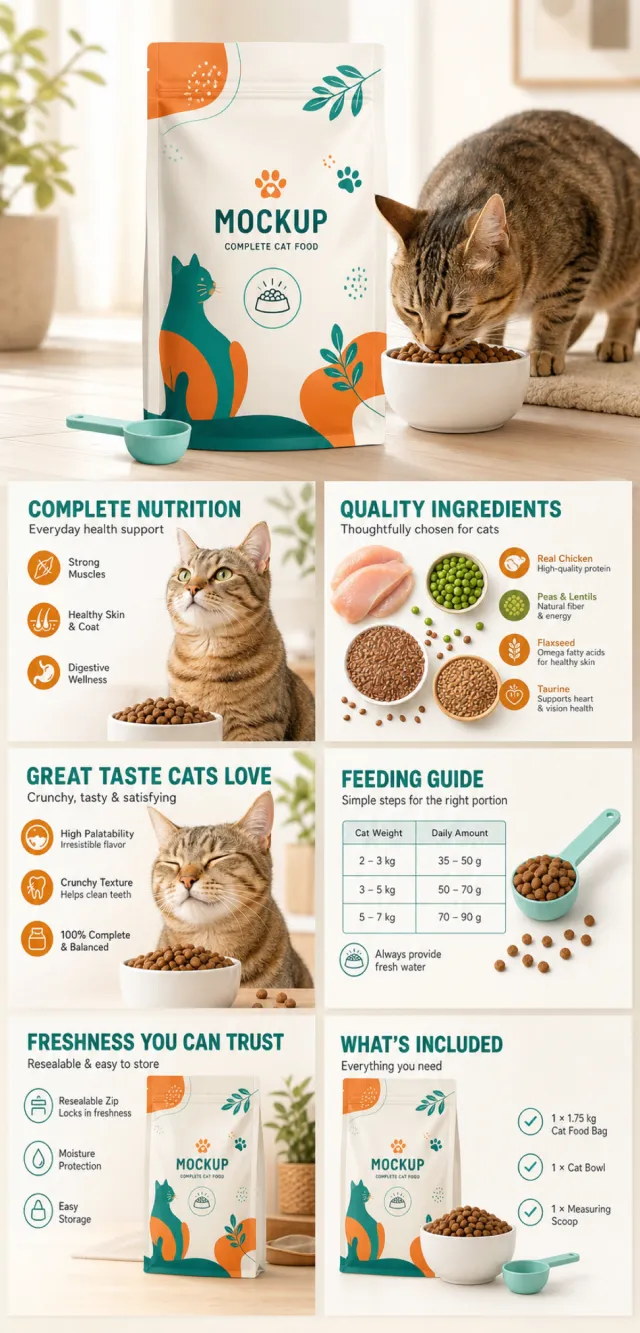
【Execution Route | Must Not Appear on Screen】 If the image-generation tool can be invoked multiple times: concatenate the sharing rules with A–F separately and execute six times; each time, generate only one independent 1000×1000 square image, resulting in six sub-images. If single‑shot generation is permitted: use a 2:3 vertical canvas measuring 1200×2500, with the top approximately 30% reserved for the product’s main visual integrated into the background, and arrange A/B, C/D, and E/F in two columns by three rows to form a six‑grid layout. All six cards should be equal in size, with visual proportions close to 1:1. Do not use an outer 1:1 canvas, nor full‑width cards, cross‑column cards, merged cards, borders, frames, or white margins. 【Sharing Rules】 The provided product reference image serves as the sole basis for the product’s appearance, structure, color, quantity, accessories, and relative proportions. Product orientation: an ivory‑colored complete cat food bag, a blue‑orange graphic, a white cat bowl, and a mint‑flavored measuring spoon; showcasing feeding, storage, and set‑up scenarios. The product itself, along with any newly generated characters, animals, props, or text, must maintain natural proportions—stretching, flattening, or non‑uniform scaling is prohibited—and the background must extend fully across all four edges. Branding must uniformly follow the MOCKUP style; remove original branding, logos, watermarks, contact information, social media accounts, platform details, gibberish, and irrelevant content. Copywriting should be concise, clear, and credible, retaining the language of the reference image, without adding unsubstantiated absolute claims or medical promises. A–F are merely control markers and must not appear on screen. 【A | Core Selling Point】 Highlight the product’s most important value and its primary subject; keep the title short and clear. 【B | Structure and Materials】 Showcase key structural elements, materials, or accessories through close-up shots or simple annotations, adhering to the product’s intended orientation. 【C | Real‑World Use】 Generate natural human/animal figures or everyday scenes to demonstrate realistic usage, ensuring proportions and actions are believable. 【D | Details and Steps】 Use close-ups, step-by-step instructions, or flowcharts to explain operations, textures, interfaces, storage solutions, or care‑related details. 【E | Lifestyle】 Illustrate how the product seamlessly integrates into family life, commuting, outdoor activities, travel, or work settings. 【F | Sets and Portability】 Accurately depict the product, its accessories, quantities, and storage relationships; do not add components absent from the reference image.
- 2M
- 2K
- $2K
- 549K
- 1K
- $11K
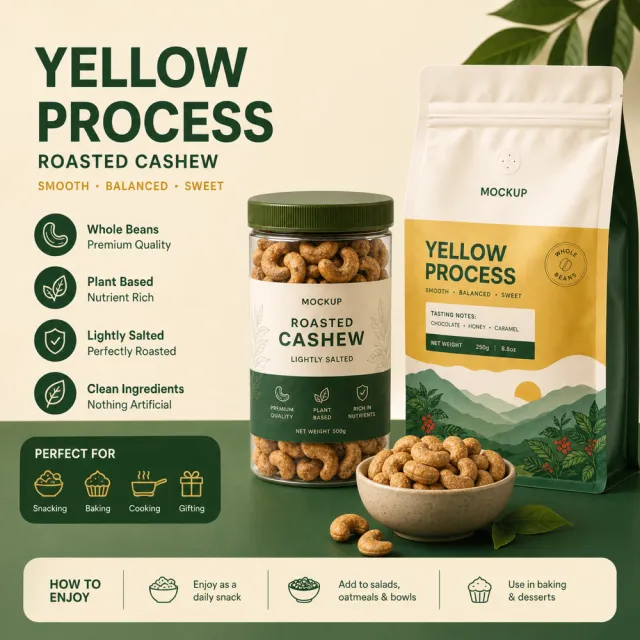
【Output Rules | Do Not Display】 Generate only one 1000×1000, 1:1 Amazon Listing secondary image. No collage images, six-grid layouts, multi-card grids, or multiple scenes are allowed. 【Sharing Rules】 Use the provided product reference image as the sole basis for the product. Product: ground coffee and roasted cashew bundle. Copy must be in English, with brand placeholders replaced by MOCKUP only. Visuals should follow premium commercial e-commerce photography standards and maintain stable graphic design. The product’s appearance, structure, color, quantity, accessories, and relative proportions must match the reference image; products, people, icons, and props should retain natural proportions. All essential information must remain within the safe zone, with the background extending fully to all four edges. External white borders, vertical borders on left and right, transparent edge fills, watermarks, contact details, social media accounts, platform information, original branding, gibberish, irrelevant information, or unverified claims regarding efficacy or specifications are prohibited. Headlines must not appear. 【Image Composition】 Layout and Content: - Create a balanced square composition featuring a prominent product hero, a clear headline, brief benefit copy, and an appropriate usage or lifestyle scene. - Ensure the product remains complete and dominant without any outer frame. Visual Style: - Employ premium commercial e-commerce photography combined with stable graphic design. - Use clean solid fills or crisp gradients with a color palette tailored to the product; no Gaussian-blurred backgrounds. Copy: - Write concise, credible e-commerce copy in English. - Include a product-name headline and short benefit statements relevant to the product. - Keep text readable and avoid lengthy paragraphs or tiny labels. People / Animals: - If a usage scene benefits from including a person or animal, create a new, recognizable subject with natural anatomy playing a supporting role.
- 246K
- 506
- $13
- 3M
- 3K
- $1K
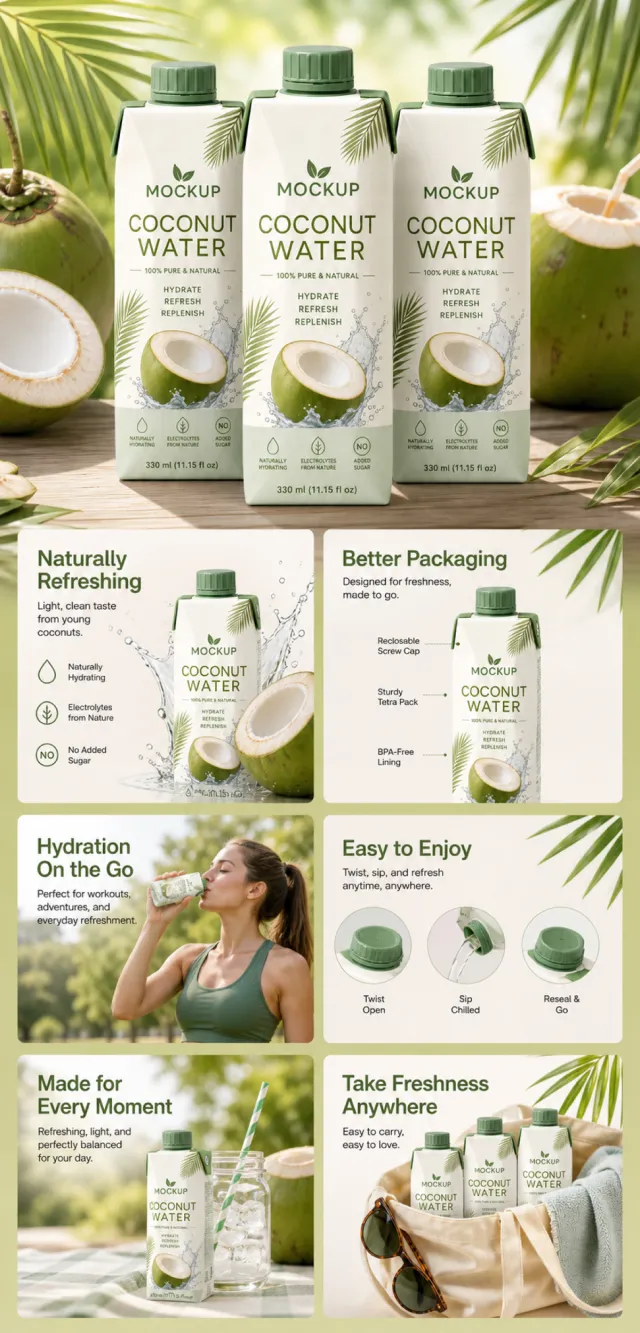
【Execution Route | Must Not Appear on Screen】 If the image-generation tool can be invoked multiple times: concatenate the sharing rules with A–F separately and execute six times; each time, generate only one independent 1000×1000 square image, resulting in six secondary images. If single‑shot generation is permitted: use a 2:3 vertical canvas measuring 1200×2500, with the top approximately 30% reserved for the product’s main visual integrated into the background, and arrange the remaining area into a 2‑column × 3‑row grid labeled A/B, C/D, and E/F. All six cards should be equal in size, with visual proportions close to 1:1. Do not use an outer 1:1 canvas, nor full‑width cards, cross‑column cards, merged cards, borders, frames, or white margins. 【Sharing Rules】 The provided product reference image serves as the sole basis for product appearance, structure, color, quantity, accessories, and relative proportions. Product orientation: coconut water packaging and coconut elements; refreshing consumption, sports hydration, cold beverages, easy opening, and portability—avoiding absolute health claims. Products, as well as newly generated characters, animals, props, and text, must maintain natural proportions; stretching, flattening, or non‑uniform scaling is prohibited. The background should extend fully across all four edges. Use MOCKUP consistently for branding; remove original brand elements, logos, watermarks, contact information, social media accounts, platform details, gibberish, and irrelevant content. Copywriting should be concise, clear, and credible, maintaining the language of the reference image, without adding unsupported absolute or medical claims. A–F are merely control markers and must not appear on screen. 【A | Core Selling Point】 Highlight the product’s most important value and its complete main subject; keep the headline short and clear. 【B | Structure & Materials】 Showcase key structural features, materials, or components using close-up shots or simple annotations, adhering to the product’s thematic direction. 【C | Real‑World Usage】 Generate natural scenes featuring people, animals, or everyday life to demonstrate realistic usage, ensuring believable proportions and actions. 【D | Details & Steps】 Use close-ups, step-by-step illustrations, or flowcharts to explain operations, textures, interfaces, storage, or maintenance details. 【E | Lifestyle】 Depict how the product naturally integrates into family life, commuting, outdoor activities, travel, or work settings. 【F | Sets & Carrying】 Accurately present the product, its accessories, quantities, and storage relationships; do not add any components absent from the reference image.
- 145K
- 394
- $53
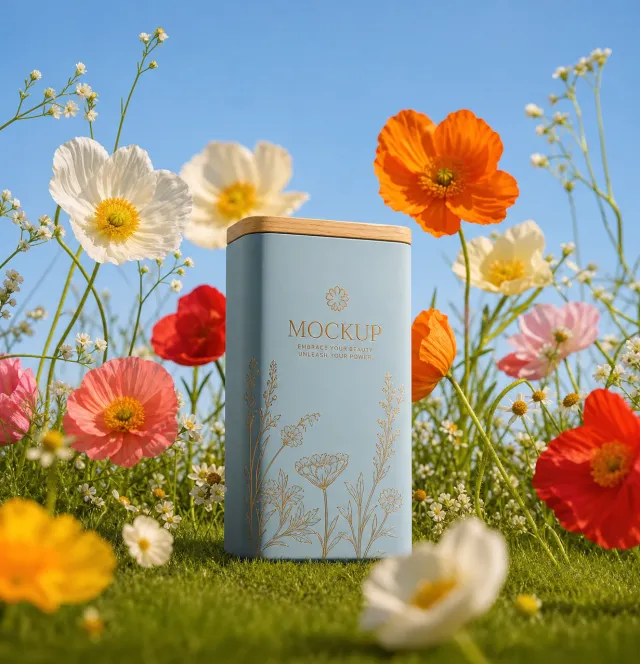
Use the supplied reference image as the sole locked product input. Preserve the product's exact appearance, structure, materials, colors, proportions, logo, label, accessories, and product-set relationship. Create a 1231:1277 photorealistic commercial product poster. Place the single blue rectangular canister upright on green grass among tall red, orange, pink, and white poppies. Use a low camera angle, bright blue sky, and clear cheerful sunlight. Use a polished premium advertising finish with crisp product focus, coherent perspective, realistic materials, controlled depth of field, and physically plausible lighting. Keep all decorative elements physically plausible and subordinate to the product. Keep existing product text legible when present. No poster text, watermark, extra product, unrelated logo, distorted object, changed product appearance, or unnecessary person.
- 2M
- 2K
- $284
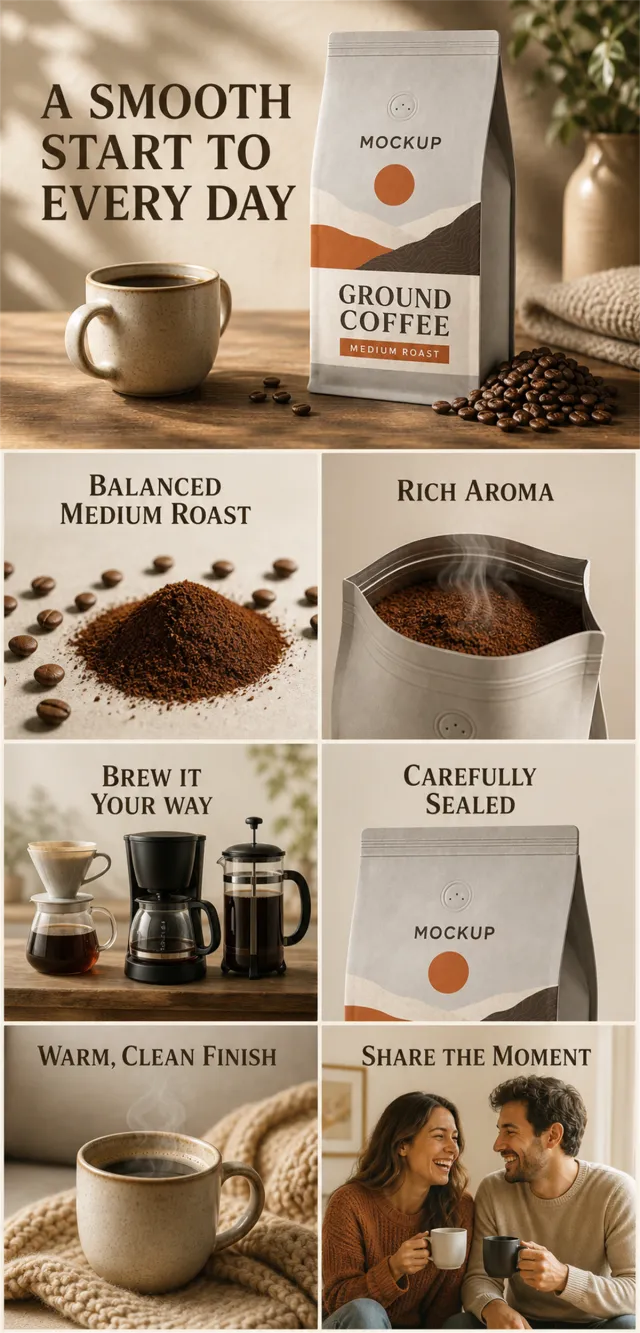
【Execution Routing | Do Not Display】 If the image-generation tool can be invoked multiple times: concatenate the sharing rules with A–F separately, execute six times, generating one 1000×1000 square image each time; do not submit all modules at once. If only one image can be generated per run: set the interface or API to a 2:3 portrait orientation and disable Auto mode; a recommended size is 1200×1800. Arrange the images in a 2-column × 3-row grid corresponding to A/B, C/D, and E/F, ensuring all six modules are equal in size and maintain a 1:1 aspect ratio. If the platform enforces a 1:1 ratio, switch to using an Agent or generate each module individually. 【Sharing Rules】 Use the provided product reference image as the sole basis for the product. Product: medium-roast ground coffee. Copywriting must be in English, with brand placeholders replaced by MOCKUP only. Visuals should employ warm editorial tones of cream, terracotta, and espresso. The product’s appearance, structure, color, quantity, accessories, and relative proportions must match the reference image; products, figures, icons, and props should maintain natural proportions. All essential information must remain within the safe zone, with the background extending fully across all four edges. External white borders, vertical borders on left and right, transparent fill-in borders, watermarks, contact details, social media accounts, platform information, original branding, gibberish, irrelevant content, or unverified claims regarding efficacy or specifications are prohibited; titles must not be displayed. A–F must not appear. 【A | Theme】Copy: “A SMOOTH START TO EVERY DAY”; “BALANCED MEDIUM ROAST.” Use the full product main visual to clearly convey the core value. 【B | Theme】Copy: “RICH AROMA.” Design an independent square image around this theme, ensuring it avoids duplicating selling points, compositions, or product angles used in other modules. 【C | Theme】Copy: “BREW IT YOUR WAY.” Design an independent square image around this theme, ensuring it avoids duplicating selling points, compositions, or product angles used in other modules. 【D | Theme】Copy: “CAREFULLY SEALED.” Design an independent square image around this theme, ensuring it avoids duplicating selling points, compositions, or product angles used in other modules. 【E | Theme】Copy: “WARM, CLEAN FINISH.” Design an independent square image around this theme, ensuring it avoids duplicating selling points, compositions, or product angles used in other modules. 【F | Theme】Copy: “SHARE THE MOMENT.” Design an independent square image around this theme, ensuring it avoids duplicating selling points, compositions, or product angles used in other modules.
- 657K
- 3K
- $230K
- 1M
- 3K
- $250
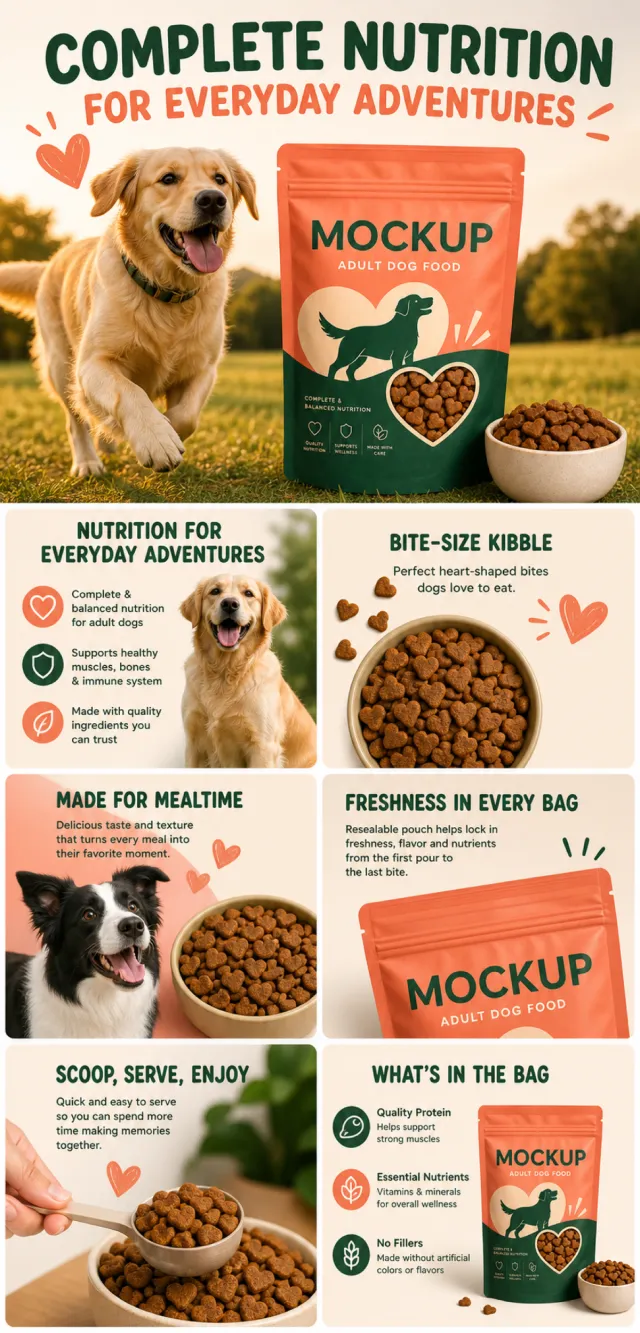
【Execution Route | Must Not Appear on Screen】 If the image-generation tool can be invoked multiple times: concatenate the sharing rules with A–F separately, and execute six times; each time, generate only one 1000×1000 square image. If only a single image can be generated at a time: first set the interface/API to a 2:3 portrait orientation and do not use Auto; then arrange images in a 2-column × 3-row grid labeled A/B, C/D, and E/F. All six cells must be equal in size, with a visual aspect ratio of 1:1. Do not use an outer canvas with a 1:1 ratio. 【Sharing Rules】 The provided product reference image serves as the sole basis for the product’s appearance, structure, color, quantity, accessories, and relative proportions. The product is a resealable adult dog food bag in coral orange and dark green, featuring a heart-shaped dog illustration on the front and a transparent heart-shaped granule window, accompanied by a bowl of heart-shaped kibble. The visual style employs warm pet-food infographics in coral pink, dark green, and cream tones, paired with rounded, bold English typography and soft lifestyle photography. Products, people, animals, text, icons, and props must maintain their natural proportions; stretching or independent scaling is prohibited. All essential information must remain within the safe zone, while the background extends fully across all four edges. Only MOCKUP may be used for branding. Remove any peripheral white borders, vertical sidebars, numbered corner labels, watermarks, contact information, social media accounts, original brand logos, platform details, gibberish, distorted body parts, and unrelated elements. People and animals must be newly rendered. Copy should be concise, readable, and trustworthy; A–F are solely control markers and must not appear on screen. 【A | Core Benefit】Title: “NUTRITION FOR EVERYDAY ADVENTURES.” Depict the dog food bag alongside a newly rendered happy adult dog, emphasizing complete daily meals without mentioning medical benefits. 【B | Kibble Display】Title: “BITE-SIZE KIBBLE.” Show close-up views of heart-shaped kibble and a bowl, preserving realistic textures and natural sizes. 【C | Dining Scene】Title: “MADE FOR MEALTIME.” Render a newly created dog quietly eating in a bright kitchen, with the packaging positioned safely within the designated area. 【D | Packaging Design】Title: “FRESHNESS IN EVERY BAG.” Provide three close-up shots focusing on the sealing strip, stable bag bottom, and transparent granule window, describing only visible structural elements. 【E | Feeding Method】Title: “SCOOP, SERVE, ENJOY.” Present a straightforward three-step process—open, measure, pour into the bowl—with actions naturally aligned to the packaging’s proportions. 【F | Product Overview】Title: “WHAT’S IN THE BAG.” Fully display the packaged product, bowl, and kibble neatly arranged, accompanied by brief, credible labeling.
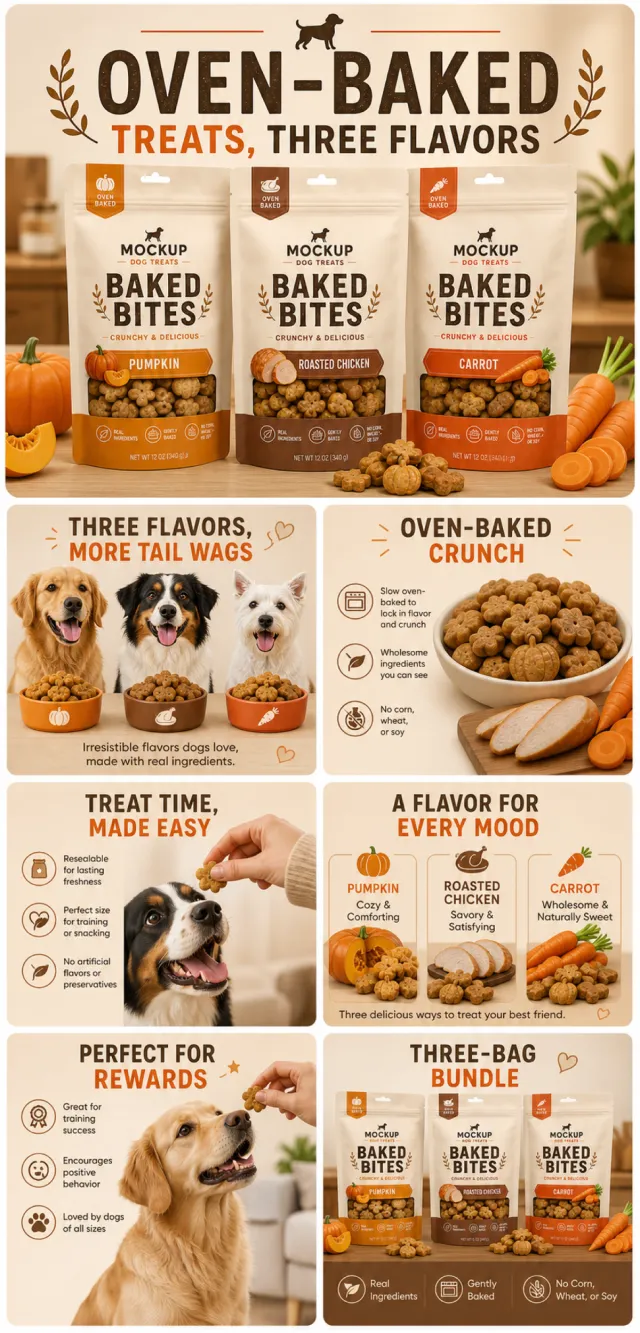
【Execution Route | Must Not Appear on Screen】 If the image-generation tool can be invoked multiple times: concatenate the sharing rules with A–F separately, and execute six times; each time, generate only one 1000×1000 square image. If only one image can be generated at a time: first set the interface/API to a 2:3 portrait orientation and do not use Auto; then arrange images in a 2-column × 3-row grid labeled A/B, C/D, and E/F. All six cells must be equal in size, with a visual aspect ratio of 1:1. The outer canvas must not be 1:1. 【Sharing Rules】 Use the provided product reference image as the sole basis for product appearance, structure, color, quantity, accessories, and relative proportions. The product is a three-bag beige, resealable dog baking snack set, featuring pumpkin orange, roasted chicken brown, and carrot orange flavor blocks, accompanied by a small number of flower-shaped and pumpkin-shaped treats. Visuals should convey a warm, baked-food aesthetic using beige, cocoa brown, and pumpkin orange tones, with friendly, bold English typography and natural ingredient photography. Maintain natural proportions for products, people, animals, text, icons, and props; stretching or independent scaling is prohibited. Ensure all essential information remains within the safe area, with the background extending fully across all four edges. Use MOCKUP exclusively for branding. Remove any peripheral white borders, vertical sidebars, numbered corner labels, watermarks, contact information, social media accounts, original brand logos, platform details, gibberish, distorted limbs, and irrelevant content. People and animals must be recreated from scratch. Copy should be concise, readable, and trustworthy; A–F are solely control markers and must not appear on screen. 【A | Core Selling Point】Title: “THREE FLAVORS, MORE TAIL WAGS.” Arrange three bags of product as heroes, introducing three different dog breeds eagerly anticipating their snacks. 【B | Baked Texture】Title: “OVEN-BAKED CRUNCH.” Close-up shots of snack textures and visual elements representing the three flavors, without making absolute health claims. 【C | Real Moment】Title: “TREAT TIME, MADE EASY.” A hand naturally offers a single treat while the dog maintains a relaxed sitting posture, with the packaging clearly visible. 【D | Flavor Combination】Title: “A FLAVOR FOR EVERY MOOD.” Each bag features visual cues—pumpkin, roasted chicken, and carrot—arranged in a clear layout. 【E | Usage Scenarios】Title: “PERFECT FOR REWARDS.” Four unnumbered scenarios: training, post-walk, daily interaction, and celebration. 【F | Package Contents】Title: “THREE-BAG BUNDLE.” Three bags and a small selection of treats laid out flat, with accurate quantities, colors, and relative sizes.
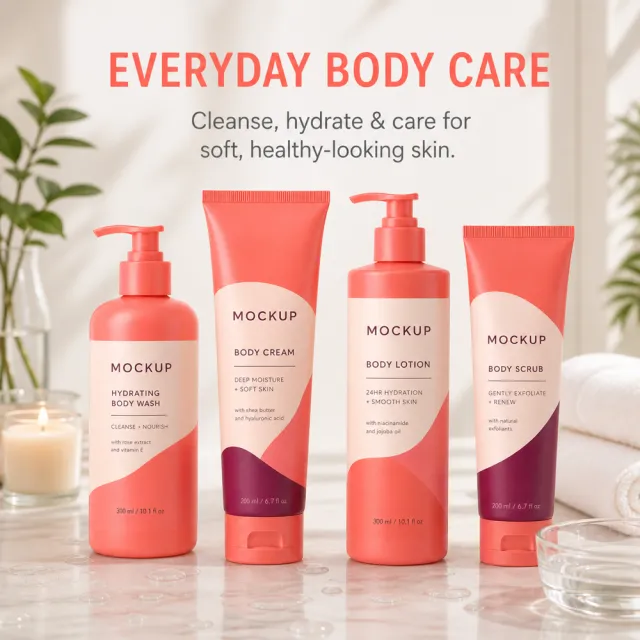
【Output Guidelines | Must Not Appear in the Image】 Generate only one final 1000×1000, 1:1 Amazon Listing secondary image. Do not use collage, six‑panel grids, storyboards, multi‑card grids, split‑top/bottom layouts, or second images. 【Sharing Guidelines】 Use the provided product reference image as the sole basis for depicting the product’s appearance, structure, color, quantity, accessories, and relative proportions. Product orientation: Coral Red Body Care Four-Piece Set; a bright bathroom lifestyle emphasizing cleanliness, hydration, and care. The product must be presented in its entirety, with all subjects, props, and text maintaining natural proportions—no stretching, flattening, cropping, or independent non‑proportional scaling is allowed. The background should extend fully to all four edges. Use MOCKUP consistently across all branding; remove any original brand elements, logos, watermarks, contact information, social media handles, platform details, gibberish, or irrelevant content. Copywriting should be concise, clear, and credible, retaining the language of the reference image and refraining from adding unverified absolute claims or medical promises. Generate new, natural human or animal figures—do not replicate characters from the original image. 【Image Composition】 Create a single, complete, single‑scene product secondary image: place the product at the visual center, integrate it with a natural lifestyle scene that aligns with the product’s intended theme, preserve all product information and maintain safe margins, ensure harmonious blending between background and subject, and avoid white borders, vertical sidebars, outer frames, or collage boundaries.
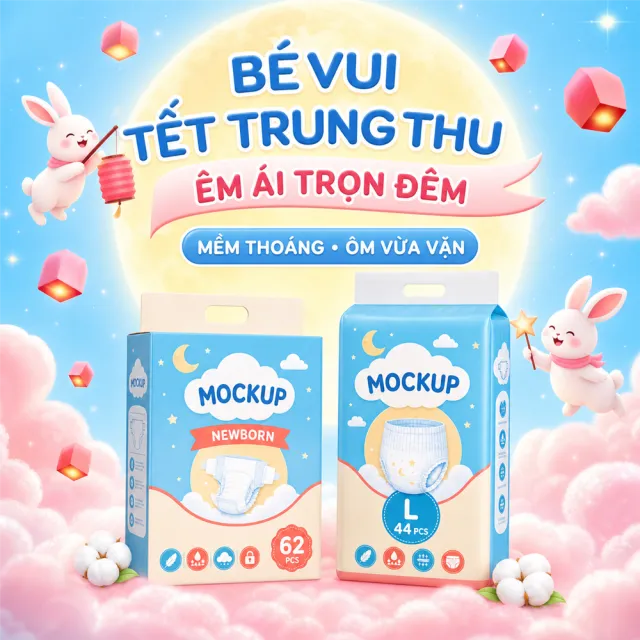
【Output Rules | Do Not Display】 Generate only one 1000×1000, 1:1 Amazon Listing secondary image. No collages, six-grid layouts, multi-card grids, or multiple images are allowed. 【Sharing Rules】 Use the provided product reference image as the sole basis for the product. Product: two-pack baby diapers. Copywriting must be in Vietnamese; brand placeholders should use MOCKUP only. Visuals should follow high-end commercial e-commerce photography standards—sharp imagery, clear hierarchy, and concise, easy-to-read copy. The product’s appearance, structure, colors, quantity, accessories, and relative proportions must match the reference image exactly; products, people, icons, and props must maintain natural proportions. All essential information must remain within the safe zone, with the background extending fully to all four edges. External white borders, vertical borders on left and right, transparent edge fills, watermarks, contact details, social media accounts, platform information, original branding, gibberish, irrelevant content, or unverified claims regarding efficacy or specifications are prohibited. Headlines must not be displayed. 【Image Composition】 Place both packages on a pink cloud beneath a moon adorned with illustrated moon rabbits and lantern cubes. Use the exact copy: "B脢 VUI T岷綯 TRUNG THU", "脢M 脕I TR峄孨 膼脢M", "M峄€M THO脕NG • 脭M V峄狝 V岷禢". Employ sky blue, cotton pink, and moon yellow tones. Ensure the packages appear complete and natural.