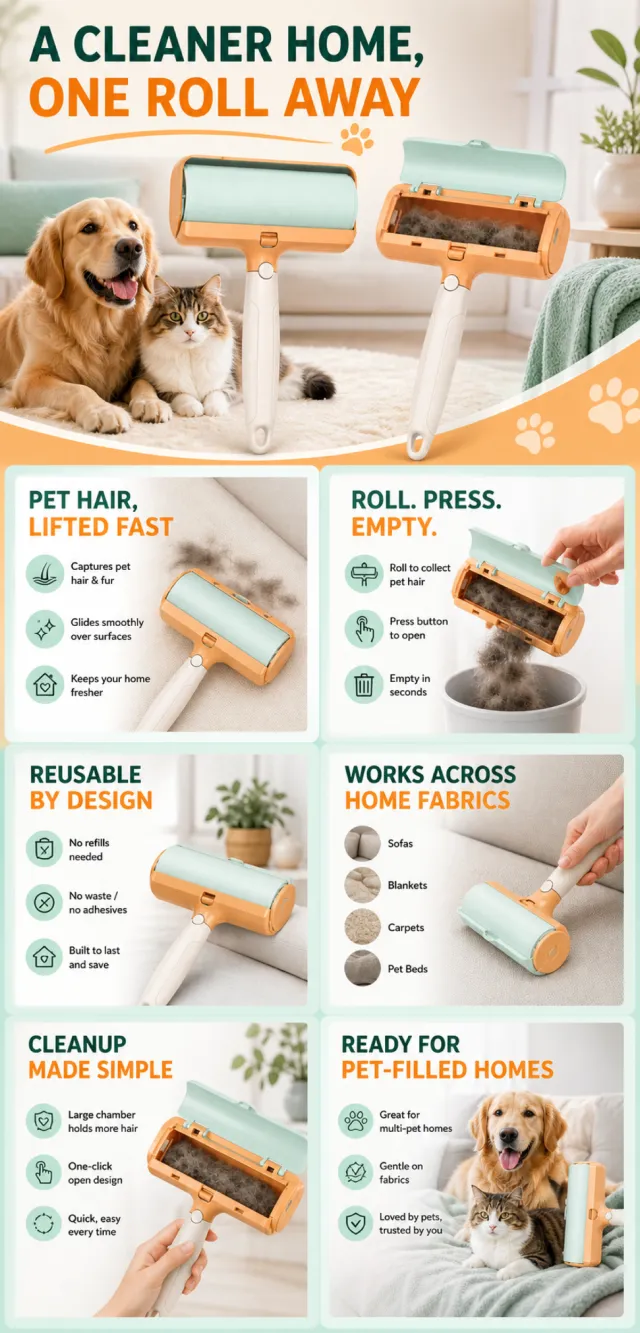
【Execution Route | Must Not Appear on Screen】 If the image-generation tool can be invoked multiple times: concatenate the sharing rules with A–F separately, and execute six times; each time, generate only one 1000×1000 square image. If only a single image can be generated at a time: first set the interface/API to a 2:3 portrait orientation and disable Auto; then arrange images in a 2-column × 3-row grid labeled A/B, C/D, and E/F. All six cells must be equal in size, with a visual aspect ratio of 1:1. The outer canvas must not be 1:1. 【Sharing Rules】 Use the provided product reference image as the sole basis for the product’s appearance, structure, color, quantity, accessories, and relative proportions. The product is a reusable pet hair removal roller in mint green, apricot orange, and off-white, featuring a long handle and an openable hair collection chamber, showcasing both closed and open states. The visual style employs fresh, home‑inspired pet‑related infographics in mint green and apricot orange, with bold English text and bright, realistic indoor photography. Maintain natural proportions for products, people, animals, text, icons, and props; stretching or independent scaling is prohibited. Ensure all essential information remains within the safe zone, with the background extending fully across all four edges. Use “MOCKUP” exclusively for branding. Remove any peripheral white borders, vertical sidebars, numbered corner labels, watermarks, contact information, social media accounts, original brand logos, platform details, gibberish, distorted limbs, and irrelevant content. People and animals must be recreated from scratch. Copy should be concise, readable, and credible; A–F are solely control markers and must not appear on screen. 【A | Core Cleaning】Title: “PET HAIR, LIFTED FAST.” Feature a hero shot of the product rolling across a fabric sofa surface, clearly showing the areas before and after cleaning. 【B | Operation Process】Title: “ROLL. PRESS. EMPTY.” Depict three simple actions without numerical breakdown: roll back and forth, press to open the chamber, and empty out the collected hair. 【C | Reusability】Title: “REUSABLE BY DESIGN.” Show the product in both closed and open states within the same frame, emphasizing the hair-collection chamber design while avoiding comparisons involving consumables. 【D | Applicable Surfaces】Title: “WORKS ACROSS HOME FABRICS.” Illustrate five real-life scenarios: sofas, blankets, clothing, pet beds, and car seats. 【E | Structural Details】Title: “CLEANUP MADE SIMPLE.” Provide close-up shots of the roller’s surface, the opening button, the hair-collection chamber, and the handle. 【F | Pet‑Friendly Home】Title: “READY FOR PET-FILLED HOMES.” Introduce newly rendered scenes of cats and dogs alongside a tidy living room, with the product prominently placed in the foreground.