Ergonomic Creative Inspiration

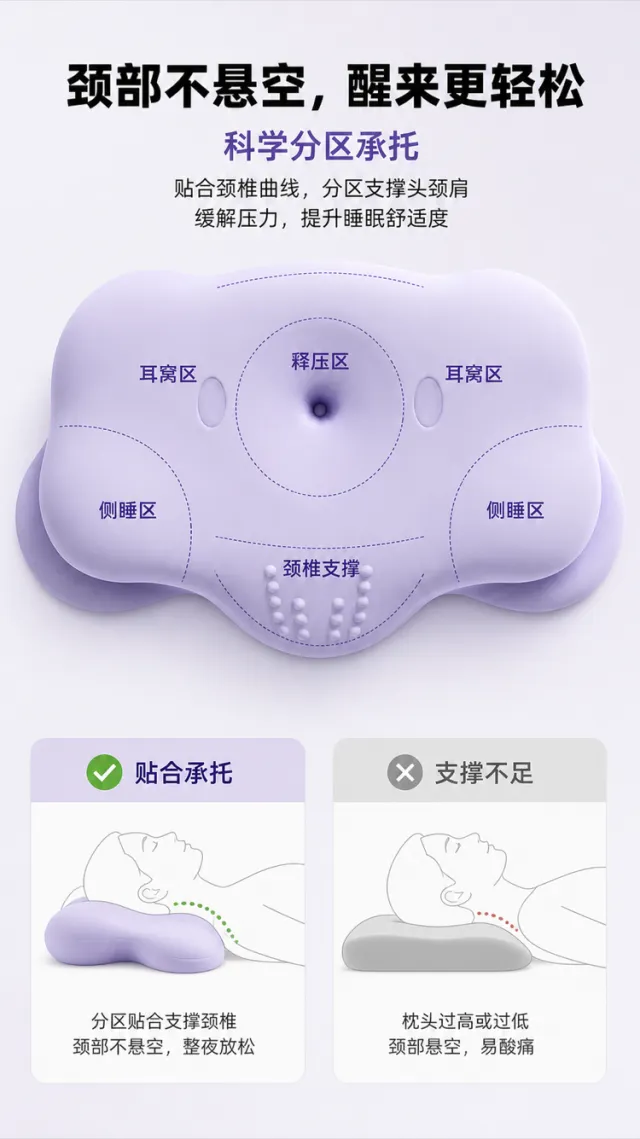
Based on the reference image, generate a visual mockup for an e‑commerce product detail page featuring a partitioned, neck-support pillow. A pale lavender‑purple ergonomic neck pillow is displayed centered in a top‑down view, retaining its butterfly‑shaped silhouette, central neck cradle, side sleep zones, ear rests, and lower cervical support area. Minor adjustments have been made to the micro‑perforations, curved surfaces, and edge details, while the product’s surface remains free of any brand markings, logos, slogans, or decorative text. The background is a clean, light gray‑purple hue, with fine dashed lines clearly dividing the pillow into “Ear Rest Zone,” “Side Sleep Zone,” “Cervical Support,” and “Pressure‑Relief Zone.” At the top, centered in bold black Chinese characters, reads the main headline: “No Hanging Neck, Easier Morning Wake‑Up.” Below it, in purple and medium weight, is the subheadline: “Scientific Partitioned Support,” accompanied by a brief two‑line description. At the bottom, two side‑by‑side comparison cards are presented: the left card features a pale purple pillow alongside a diagram of proper sleeping posture, marked with a green checkmark and the text “Close Fit, Perfect Support”; the right card contrasts this with a gray, older pillow, highlighted by a gray X and the text “Insufficient Support.” The typography is soft yet professional, with clear, unobtrusive zone labels and dashed lines that do not obscure the pillow’s main form, while maintaining balanced white space throughout the composition. Output dimensions: 750 x 1334 px. Avoid: real brands, model numbers, footnotes, garbled text, watermarks, overlapping text, text overflow, subject obstruction, distorted proportions, duplicate products, low‑resolution icons, and excessive negative space.

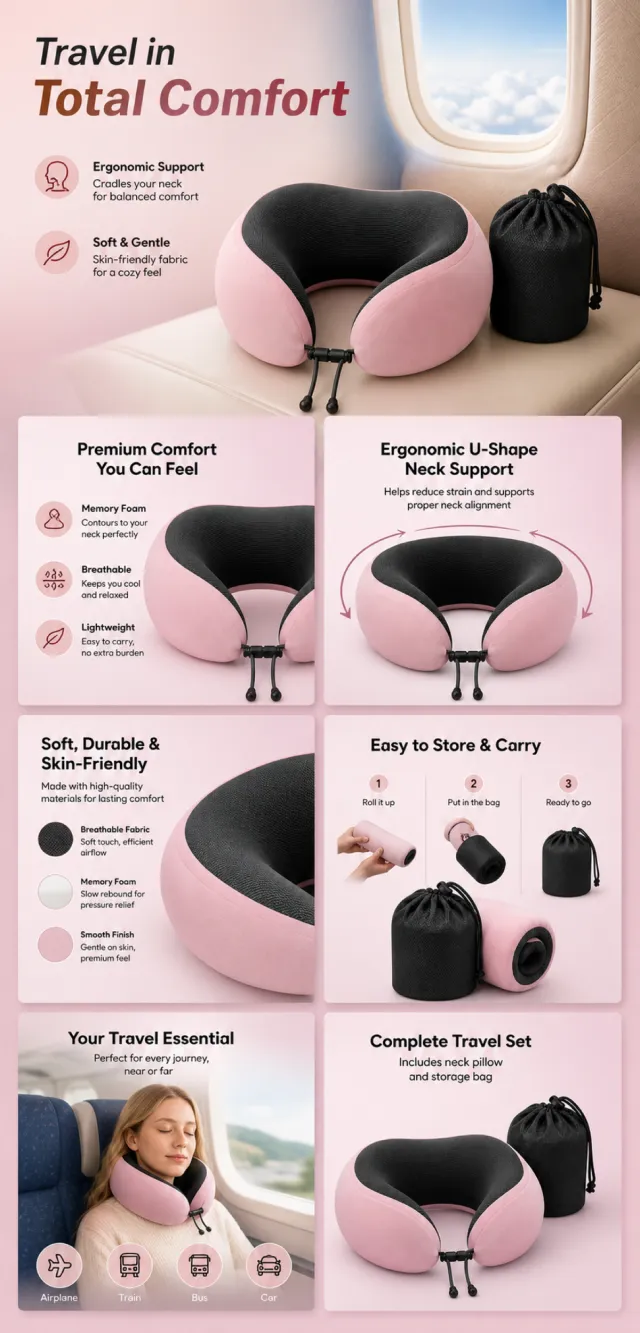
【Execution Route | Must Not Appear on Screen】 If the image-generation tool can be invoked multiple times: concatenate the sharing rules with A–F separately and execute six times; each time, generate only one independent 1000×1000 square image, resulting in six sub-images. If the tool can only generate once: use a 2:3 vertical canvas measuring 1200×2500, with approximately 30% at the top reserved for the product’s main visual integrated into the background, and arrange the remaining area into a 2-column × 3-row grid labeled A/B, C/D, and E/F. All six cards should be of equal size, with an aspect ratio close to 1:1. Do not use a 1:1 outer canvas, nor full-width cards, cross-column cards, merged cards, borders, frames, or white margins. 【Sharing Rules】 The provided product reference image serves as the sole basis for the product’s appearance, structure, color, quantity, accessories, and relative proportions. Product orientation: pink U-shaped travel neck pillow, black interior, and storage pouch; supportive, soft, foldable, airport‑friendly, and portable. The product itself, along with any newly generated characters, animals, props, or text, must maintain natural proportions—stretching, flattening, or non‑uniform scaling is prohibited—and the background must extend fully across all four edges. Branding must uniformly follow the MOCKUP style; remove original branding, logos, watermarks, contact information, social media handles, platform details, gibberish, and irrelevant content. Copywriting should be concise, clear, and credible, retaining the language of the reference image without adding unsubstantiated absolute claims or medical promises. A–F are merely control markers and must not appear on screen. 【A | Core Selling Point】 Highlight the product’s most important value and its complete main subject; keep the headline short and clear. 【B | Structure & Materials】 Showcase key structural elements, materials, or components using close-up shots or simple annotations, adhering to the product’s intended orientation. 【C | Real‑World Use】 Generate natural scenes featuring people, animals, or everyday settings to demonstrate realistic usage, ensuring proportions and actions appear believable. 【D | Details & Steps】 Use close-ups, step-by-step instructions, or flowcharts to explain operations, textures, interfaces, storage solutions, or care details. 【E | Lifestyle】 Illustrate how the product seamlessly integrates into daily life scenarios such as home, commuting, outdoor activities, travel, or work. 【F | Sets & Carrying】 Accurately depict the product, its accessories, quantities, and storage relationships; do not add any components absent from the reference image.

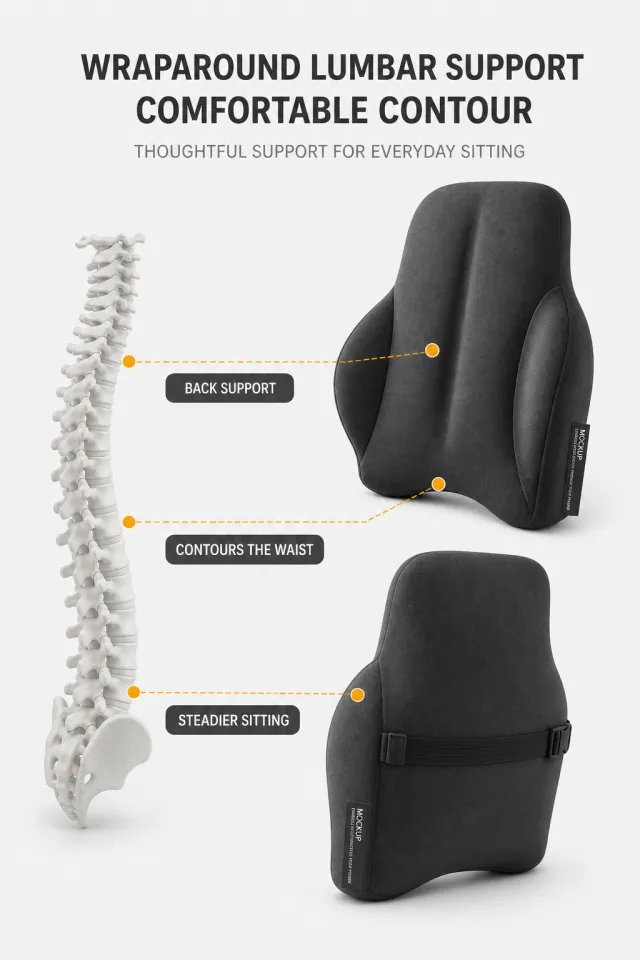
Based on the provided white-background product images, generate an ergonomic lumbar support detail page poster. The background is clean gray and white, with two central lines of dark gray titled "Lumbar Support / Comfortable Fit" at the top, and a light gray line below for explanation. On the left side, place a simple light gray spine model, marking the support positions along the three spine nodes with orange-yellow dots; On the right side, two dark gray lumbar support angle diagrams are placed vertically, with the upper one showing the front side angle and the lower showing the back angle, connected by thin dashed lines to the spinal node. The labels use "Back Support," "Waist Side," and "Stable Sitting Posture." The product features dark gray cushioning, wing supports on both sides, and a groove in the middle, allowing adjustment of stitches, wing curvature, and surface texture. The product originally included brand information, using only the small side labels "MOCKUP" and "EMBRACE YOUR BEAUTY, UNLEASH YOUR POWER." The font is simple and rational sans-serific, with the title centered in bold, and the white text on the label placed in a dark gray rounded corner. Avoid spinal conditions, treatment promises, original brands, parameters, watermarks, and fine footnotes.

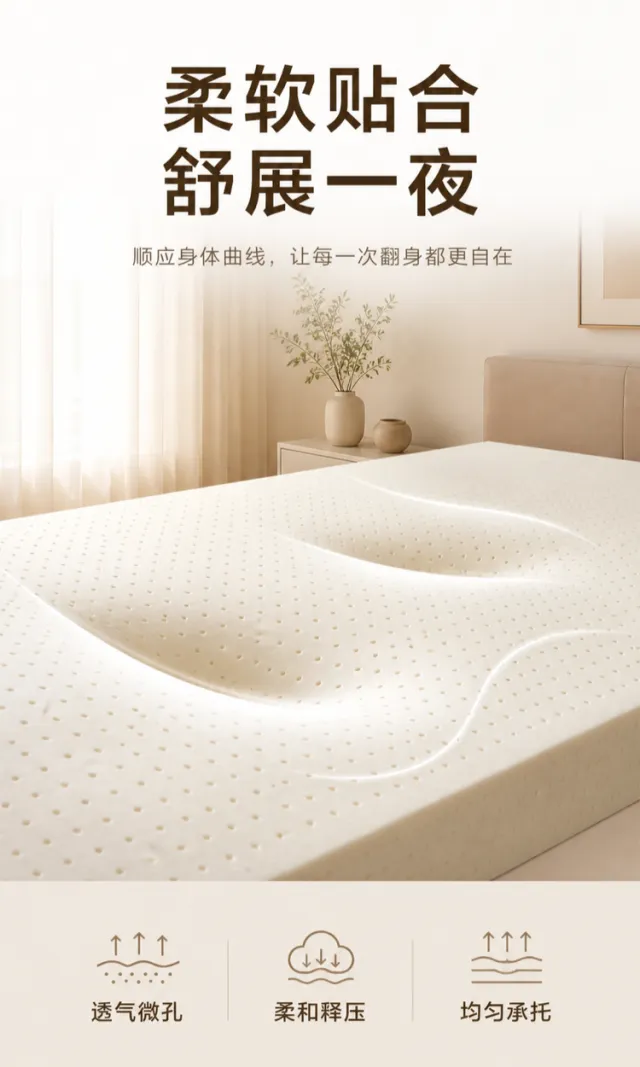
Generate a mockup for an e‑commerce product detail page showcasing the comfort and fit of a natural latex mattress. The scene features a gentle milky white and light apricot bedroom setting. A figure lies on their side atop a creamy‑white mattress with fine, breathable perforations; the surface naturally conforms to the contours of the shoulders, neck, waist, and legs. In the center of the image, a delicate, semi‑transparent arc outlines the support zone, emphasizing soft envelopment and even distribution of pressure. Bedding, walls, and window light remain softly understated, with no brand information visible. At the top, a large, minimalist title area uses elegant, subtly humanistic dark brown Chinese bold typeface. The main headline is split into two lines: “Soft & Close-Fitting” and “Unwind Through the Night.” Below, in lighter brown and smaller font, reads: “Adapts to your body’s curves, making every turn more comfortable.” Line spacing is generous, ensuring the headlines are prominent yet not overly dramatic, with no heavy shadows. Beneath, three sets of light, linear icons paired with short phrases convey “Breathable Micro‑Perforations,” “Gentle Pressure Relief,” and “Even Support.” Each card features minimal borders and ample negative space. The overall aesthetic exudes calm, clean, and cozy sleep quality. Output dimensions: 750 x 1250px. Avoid: real brand names or model numbers, footnotes, garbled text, watermarks, overlapping text, text overflow, figures or key elements obscured, low‑resolution icons, and unusual use of negative space.

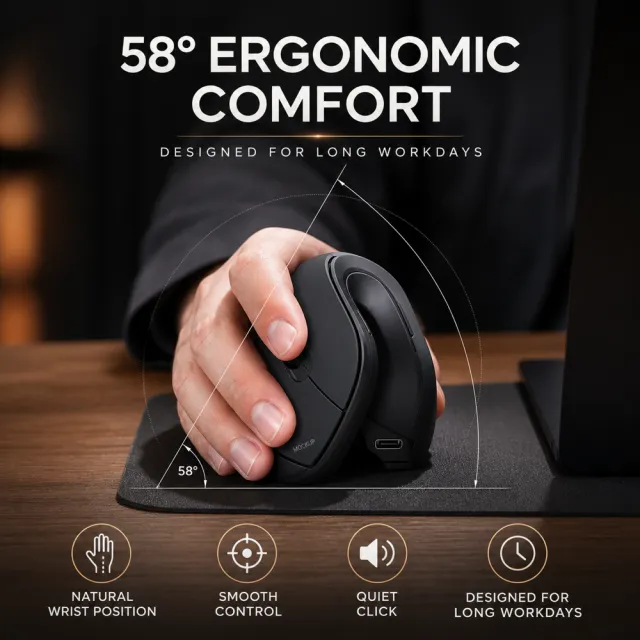
Create one standalone square 1000x1000 Amazon listing image. Use the first reference for visual direction: a lifestyle hand holding a black ergonomic mouse, a large comfort-angle headline above, a simple angle diagram overlay, and a lower row of fatigue-relief icons. Use the second reference for exact geometry: one complete black ergonomic mouse with its buttons, scroll wheel, contours, and proportions. Replace all visible copy with English-only invented copy: “58° ERGONOMIC COMFORT”, “NATURAL WRIST POSITION”, “SMOOTH CONTROL”, “QUIET CLICK”, “DESIGNED FOR LONG WORKDAYS”. Add subtle MOCKUP branding on the existing mouse surface. Preserve the dark neutral desk scene and clear technical callout style. Show one mouse only; do not invent extra buttons or accessories. No original brand, watermark, filename, contact information, copied claims, disassembled view, collage, grid, split-screen, outer white frame, or stretched product.